You are B1. You can order lunch, chat about the weekend, follow a podcast. Then the meeting starts, and someone says je rebondis sur ce que disait Marie — and your brain leaves the building.
Business French is not harder French. It is French with a different job: it has to signal respect, hold the floor, and commit people to actions. That is a learnable set of phrases, not an endless vocabulary mountain.
What you will get from this guide
- Meeting phrases organised by function, not by grammar chapter
- The formal/informal switch that decides whether you sound polite or rude
- Email formulas French colleagues actually use
- A 30-minute weekly drill that builds meeting reflexes
Why Meeting French Feels So Hard
In a café, a mistake is charming. In a meeting, a mistake can sound like an opinion you did not mean to have.
French business culture runs on vouvoiement — the formal vous — until someone explicitly invites the tu. Get that wrong and you have made a social statement you never intended. Get the connective phrases right, and you sound like a colleague instead of a guest.
Opening the Meeting
The first two minutes set your credibility for the hour.
Taking the Floor Without Trampling Anyone
Interrupting politely is the single most valuable skill in a French meeting. There is a ladder of softness — climb it properly.
The word permettre does a lot of work here. It signals that you know the floor is not yours — and that you are taking it anyway, politely.
Agreeing, Disagreeing, and the French Art of Nuance
French professional disagreement is rarely a flat non. It arrives wrapped.
Note the pattern: agree on something first, then pivot with en revanche, cela dit or cependant. This is not weakness. It is how respect is demonstrated in a French meeting.
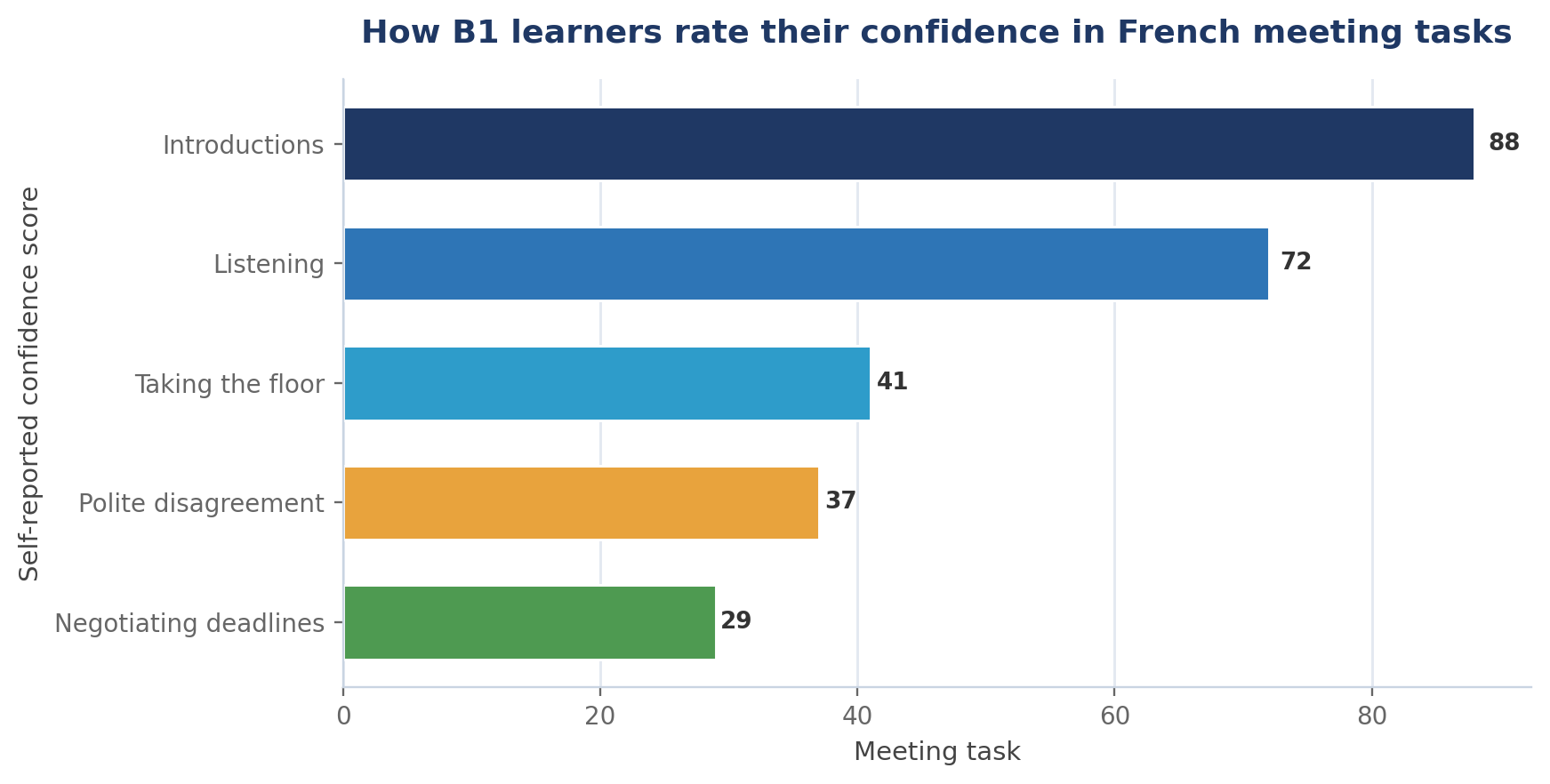
The chart tells a story you may recognise. Listening feels fine. Negotiating does not. That is because negotiation needs phrase patterns, not vocabulary — and most courses never teach them.
Meetings are 90% patterns. Learn the patterns.
Our self-paced French for Business course uses a personal AI voice tutor to put you in simulated meetings — agenda, objections, negotiation — with instant feedback that corrects your phrasing in the moment. It is rehearsal, not theory.
Practice real business French →Create a free accountPhrases That Close and Commit
A meeting that ends with nothing decided has failed. These are the closers.
Compte rendu — the written minutes — is sacred in French business. Send one quickly, and you become the reliable person.
Email Formulas That Make You Look Native
Meetings bleed into email. These are the standard fittings.
Punctuation has rules too. French uses a space before ?, !, : and ; — a small detail that instantly marks a careful writer.
The Weekly Drill That Builds Reflexes
Thirty minutes, four times a week. It works.
Do that for a month and the first thirty seconds of a French meeting stop being scary.
Walk into the next meeting and lead it.
You do not need to be fluent to be impressive — you need the right twelve phrases under pressure. Our AI voice tutor drills exactly those, with feedback on pronunciation and register.
Prepare for your next French meeting →Create a free accountFrequently Asked Questions
How formal should I be in a French business email? Always start with Bonjour or Bonjour Madame/Monsieur and a proper closing. Avoid Salut unless you already use tu with the person. When in doubt, more formal is never offensive.
Is DELF Pro worth taking for a business role? It depends on the employer. DELF Pro certifies professional French and is recognised by some French chambers of commerce, but many companies simply interview you in French. Check what your target employer asks for.
What if I only understand 60% of the meeting? Say so, warmly: Excusez-moi, pourriez-vous reformuler ? Native speakers rarely mind. Silently nodding for an hour is the real career risk.
Can I learn business French at B1? Yes. B1 is the ideal starting point, because you already have conversational grammar and can focus on register, formulas and specialised vocabulary.
References & Further Reading
- France Éducation International — DELF Pro and professional French certifications explained.
- Alliance Française — professional and business French course offers worldwide.
- Le Robert and Larousse — French dictionaries and the Petit Larousse style guidance for written register.
- Chambre de Commerce et d'Industrie (CCI France) — French business practices and trade documentation.
- RFI Économie — free French-language economic news, useful for meeting vocabulary in context.
Learn twelve phrases cold this week. Use one. That is how it starts.