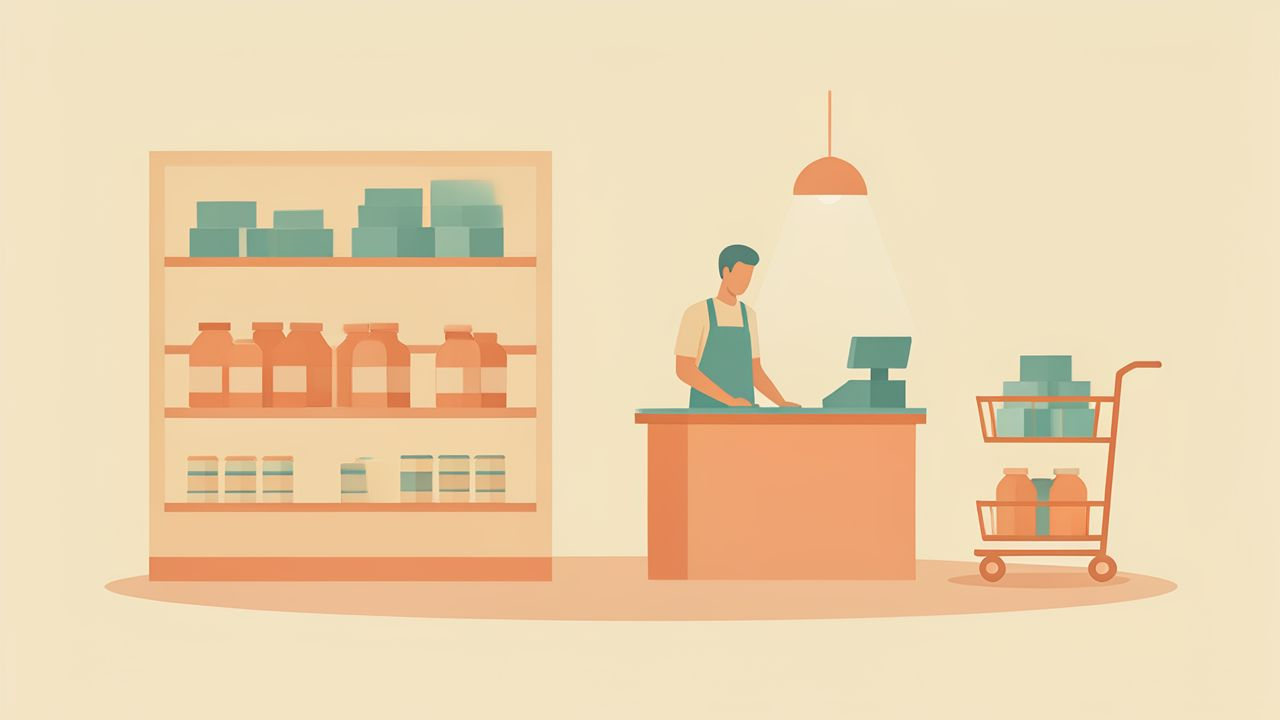
The supermarket is the single largest employer in German retail, and it is also the most accessible. Discounters and full-range chains together run tens of thousands of stores, and they hire continuously for shelf filling, fresh produce, the bakery counter and the till.
The vocabulary is narrower than in a department store and far more concrete. Almost every word on this page describes something you can pick up, cool down, scan or throw away.
The Words of the Store
| German term | English meaning |
|---|---|
| der Supermarkt | the supermarket |
| der Discounter | the discount grocery chain |
| die Filiale | the branch |
| der Markt | the store |
| der Gang | the aisle |
| das Kühlregal | the refrigerated shelf |
| das Tiefkühlfach | the freezer cabinet |
| die Obst- und Gemüseabteilung | the fruit and vegetable section |
Germany distinguishes the discounter, which sells a lean range at low prices, from the full-range store, which carries far more lines and often a service counter. That difference decides what the job involves, because a small range means faster replenishment and a wider one means more advice.
Departments and the Layout of the Store
| German term | English meaning |
|---|---|
| die Frischetheke | the fresh food counter |
| der Backshop | the in-store bakery |
| die Fleischabteilung | the meat department |
| der Getränkemarkt | the drinks section |
| die Ware | the goods |
| die Aktionsfläche | the promotional display |
| die Kassenzone | the checkout area |
| die Tiefkühlkette | the frozen chain |
A German store is laid out so that the daily necessities are at the back and the promotional displays sit on the route to them. The fresh and frozen sections run on the cold chain, which must be kept unbroken and documented, and that rule shapes how goods are received, stored and displayed.
Filling the Shelves
| German term | English meaning |
|---|---|
| das Einräumen | the filling of the shelves |
| das Mindesthaltbarkeitsdatum | the best-before date |
| die Umlaufkontrolle | the check of stock rotation |
| die Lücke | the gap on the shelf |
| die Nachbestellung | the reorder |
| die Palette | the pallet |
| die Rollcontainer | the roll cage |
| das Etikett | the label |
Stock is filled from the back, so that the older goods move to the front and are sold first, and the best-before date is checked while the shelf is in hand. A gap that is not filled by the end of the shift is a visible failure in a German store, because the customer reads it as a missing product.
Fresh Produce and Quality
| German term | English meaning |
|---|---|
| das Obst und Gemüse | the fruit and vegetables |
| das Aussortieren | the sorting out of spoiled goods |
| die Frische | the freshness |
| die Kühlkette | the cold chain |
| die Temperatur | the temperature |
| der Verderb | the spoilage |
| die Reduzierung | the price reduction |
| die Entsorgung | the disposal |
Fresh produce is sorted every day, and anything past its best is removed or reduced rather than left for the customer to judge. Temperature is measured and recorded, because a break in the cold chain is both a quality question and a legal one.
The Till and the Queue
| German term | English meaning |
|---|---|
| die Kasse | the till |
| der Kassierer | the cashier |
| das Kassensystem | the checkout system |
| das Leergut | the returnable empties |
| der Pfandautomat | the bottle return machine |
| der Beleg | the receipt |
| die Schlange | the queue |
| die Nachfrage | the enquiry |
Germany runs a deposit system on most drink containers, and the return machine is part of the till area rather than an add-on. A cashier therefore deals with the Pfand, the scanning and the payment in one short sequence, and the queue behind each customer is the real measure of the work.
Bakery, Counter Service and Weight
| German term | English meaning |
|---|---|
| der Backshop | the bakery counter |
| die Theke | the counter |
| die Waage | the scales |
| der Aufschnitt | the sliced cold cuts |
| das Brötchen | the bread roll |
| das Brot | the bread |
| die Verpackung | the packaging |
| der Kilopreis | the price per kilogram |
A German backshop bakes through the day, and the rolls are often the reason a customer chooses one chain over another. Counter service is priced by weight, so the scales and the price per kilogram are part of the vocabulary rather than a detail left to the till.
Waste, Hygiene and the Rules
| German term | English meaning |
|---|---|
| der Schwund | the shrinkage |
| die Entsorgung | the waste disposal |
| die Dokumentation | the documentation |
| die Hygiene | the hygiene |
| die Kontrolle | the inspection |
| die Vorschrift | the regulation |
| die Schulung | the training |
| das Protokoll | the record |
Food hygiene rules require documented temperatures, cleaning and training, and an inspection may ask to see all three. Waste is recorded as carefully as sales, because a store that cannot explain its shrinkage is treated as having a management problem rather than bad luck.
Pay, Night Shifts and Shift Bonuses
| German term | English meaning |
|---|---|
| der Nachtzuschlag | the night shift supplement |
| der Sonntagszuschlag | the Sunday supplement |
| der Feiertagszuschlag | the public holiday supplement |
| die Nachtschicht | the night shift |
| die Spaetschicht | the late shift |
| die Schichtleitung | the shift leader role |
| die Aushilfe | the temporary helper |
| der Werkstudent | the working student |
Supermarket work runs in shifts, and German law and branch agreements attach Zuschlaege to evenings, nights, Sundays and public holidays. The night supplement is generally the highest, which is why the early stocking and baking shifts pay more than a daytime till shift.
Aushilfen cover the busy hours, and students may work as Werkstudenten with reduced social contributions. A shift leader carries the keys, reconciles the cash and answers the first customer complaint.
A shift longer than six hours includes a break set by law, and the tills are balanced at the end of every shift. Reliability with the rota matters more than raw speed when a manager decides who to keep on. If you want to read your shift plan and your pay slip without help, learn German with the supermarket vocabulary built into the course.
The bars show the order of the stages; each value is a sequence number rather than a duration.
Working in a German Supermarket
Supermarket work is shift-based, often early in the morning before the store opens, and the contracts are frequently part-time. The pay follows a collective agreement in most chains, and the statutory minimum wage sets the floor in the rest.
The vocabulary is concrete and repeated daily, so it can be learned quickly. If you want to learn German for supermarket work, the shelf, fresh produce and till vocabulary is the practical place to begin.
Supermarket German is concrete, repeated and taught on the job. Learn German for retail work with shelves, fresh produce and tills built into the course.
Put your German to work. The LanguageSkills German course is self-paced and built around real situations like these — you speak, and your AI tutor corrects you on the spot, from A1 to B2.