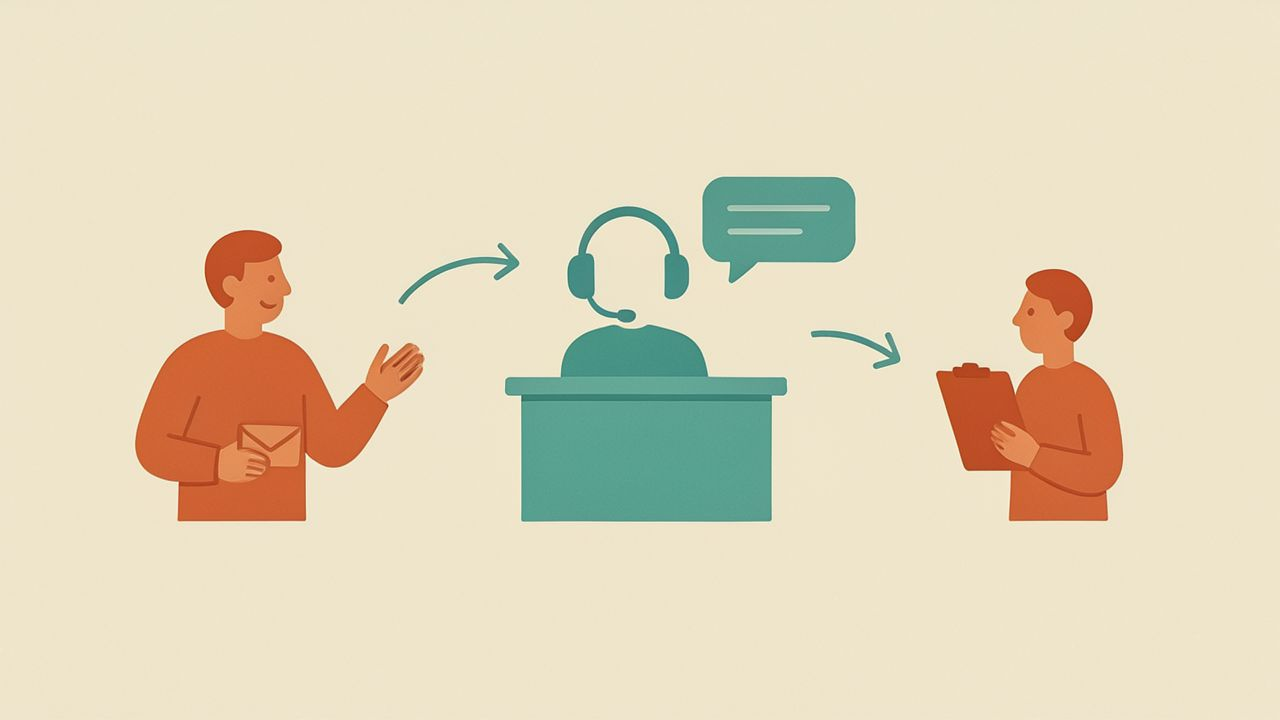
Customer service is the part of a business where language is the whole job rather than a tool for it. In Germany the standard is formal, structured and written down, and a service employee is expected to sound calm even when the customer is not.
German companies measure service carefully, and the words of that measurement are used in every team meeting. Learning them is how a new employee stops being the person who only answers the easy calls.
The Words of Customer Service
| German term | English meaning |
|---|---|
| der Kundenservice | the customer service department |
| der Kunde | the customer |
| die Anfrage | the enquiry |
| die Auskunft | the information given |
| die Beratung | the advice |
| die Beschwerde | the complaint |
| die Zufriedenheit | the satisfaction |
| der Kontakt | the contact |
Anfrage, Beschwerde and Reklamation are three different things in German, and they arrive through different channels and with different deadlines. Using the right word at the start of a conversation tells the customer immediately that you understand what they need.
Answering the Enquiry
| German term | English meaning |
|---|---|
| die Begruessung | the greeting |
| die Rueckfrage | the clarifying question |
| die Zustaendigkeit | the responsibility, the department |
| die Weiterleitung | the forwarding |
| die Weiterverbindung | the transfer of the call |
| die Wartezeit | the waiting time |
| die Zusammenfassung | the summary |
| der Rueckruf | the call back |
A German service call starts with the name of the company and the name of the person, and it ends with a summary of what was agreed. If the question belongs to another department, the word Zustaendigkeit is the reason to pass it on rather than guess an answer.
Explaining and Advising
| German term | English meaning |
|---|---|
| die Loesung | the solution |
| die Alternative | the alternative |
| die Lieferzeit | the delivery time |
| die Verfuegbarkeit | the availability |
| die Garantie | the guarantee |
| die Bedingung | the condition |
| die Empfehlung | the recommendation |
| die Erklaerung | the explanation |
Explaining clearly means naming the delivery time, the price and the condition before the customer has to ask. German customers expect the bad news in the same sentence as the good news, because they would rather adjust their plan than discover the problem later.
Handling a Complaint
| German term | English meaning |
|---|---|
| die Reklamation | the complaint about a product |
| die Entschuldigung | the apology |
| das Verstaendnis | the understanding |
| die Ursache | the cause |
| die Massnahme | the measure, the action taken |
| die Wiedergutmachung | the remedy |
| die Frist | the deadline |
| die Eskalation | the escalation |
The German way is to acknowledge the problem, name the cause if it is known, and state what will happen and by when. An apology without a Frist sounds empty, and a Wiedergutmachung offered too early can be read as an admission rather than a service.
Written Service
| German term | English meaning |
|---|---|
| das Ticket | the support ticket |
| das Ticketsystem | the ticketing system |
| die Antwortzeit | the response time |
| die Signatur | the signature block |
| die Vorlage | the template |
| das Protokoll | the record of the call |
| die Dokumentation | the documentation |
| die Aktennotiz | the file note |
Almost every German service contact leaves a written trace, and the note must record what the customer wanted, what was promised and when. Because a record can be read by the customer later, the wording is careful and free of anything that could be understood as a promise nobody made.
Measuring Satisfaction
| German term | English meaning |
|---|---|
| die Kennzahl | the key figure |
| die Bearbeitungszeit | the handling time |
| die Erstloesungsquote | the first contact resolution rate |
| die Umfrage | the survey |
| die Bewertung | the rating |
| die Beschwerdequote | the complaint rate |
| der Bericht | the report |
| die Verbesserung | the improvement |
Service teams in Germany are judged on how quickly and how completely a case is closed, and the figures are posted and discussed. A high Wiederholungsquote, the rate of customers who have to come back, is treated as a failure even when every individual call was polite.
Working with Other Departments
| German term | English meaning |
|---|---|
| die Fachabteilung | the specialist department |
| die Schnittstelle | the interface between teams |
| die Ruecksprache | the consultation |
| die Abstimmung | the coordination |
| die Verantwortung | the responsibility |
| die Uebergabe | the handover |
| die Frist | the deadline |
| die Information | the information |
A service employee rarely has the power to fix a problem alone, so the job depends on asking the right department in the right words. Clear, short internal messages with a deadline get answered, and a vague request is the reason a customer waits an extra day.
Training, Targets and Career Steps
| German term | English meaning |
|---|---|
| die Einarbeitung | the induction, the settling-in period |
| die Schulung | the training course |
| die Erstloesungsquote | the first contact resolution rate |
| die Bearbeitungszeit | the handling time |
| die Zufriedenheitsumfrage | the satisfaction survey |
| die Teamleitung | the team leadership |
| die Weiterbildung | the further training |
| die Spezialisierung | the specialisation |
A new service employee in Germany receives a short Einarbeitung, a period of supervised calls, and a written guide to the most common cases. That guide is a reference document, and knowing where to find an answer is valued more highly than pretending to know it.
Success is measured with clear figures: the Antwortzeit, the Bearbeitungszeit and the Erstloesungsquote. A team that raises the first-contact resolution rate reduces its own workload, because a problem solved on the first call never comes back.
From the service desk the route leads to Teamleitung, to quality management, or into a Fachabteilung such as complaints or technical support. Each step needs a narrower vocabulary and a deeper knowledge of the product itself.
German service training is often certified, and employers will pay for a course in communication or in the company's own systems. Asking about Weiterbildung at a review is read as ambition rather than as a complaint. If you want to handle German calls and write a clear reply, learn German with the customer service vocabulary built into the course.
The bars show the order of the stages; each value is a sequence number rather than a duration.
Working in Customer Service in Germany
Service roles are one of the most common entry points into a German office, and they are forgiving of an accent but not of vagueness. The employer is looking for someone who can listen, summarise and commit to a date in clear German.
The vocabulary you need is narrow and repeatable: enquiries, complaints, delivery times and deadlines. If you want to learn German for office and telephone work, the service language is short enough to practise until it becomes automatic.
German customer service rewards clarity, structure and a stated deadline. Learn German with enquiry, complaint and call-handling language built into the course.
Put your German to work. The LanguageSkills German course is self-paced and built around real situations like these — you speak, and your AI tutor corrects you on the spot, from A1 to B2.