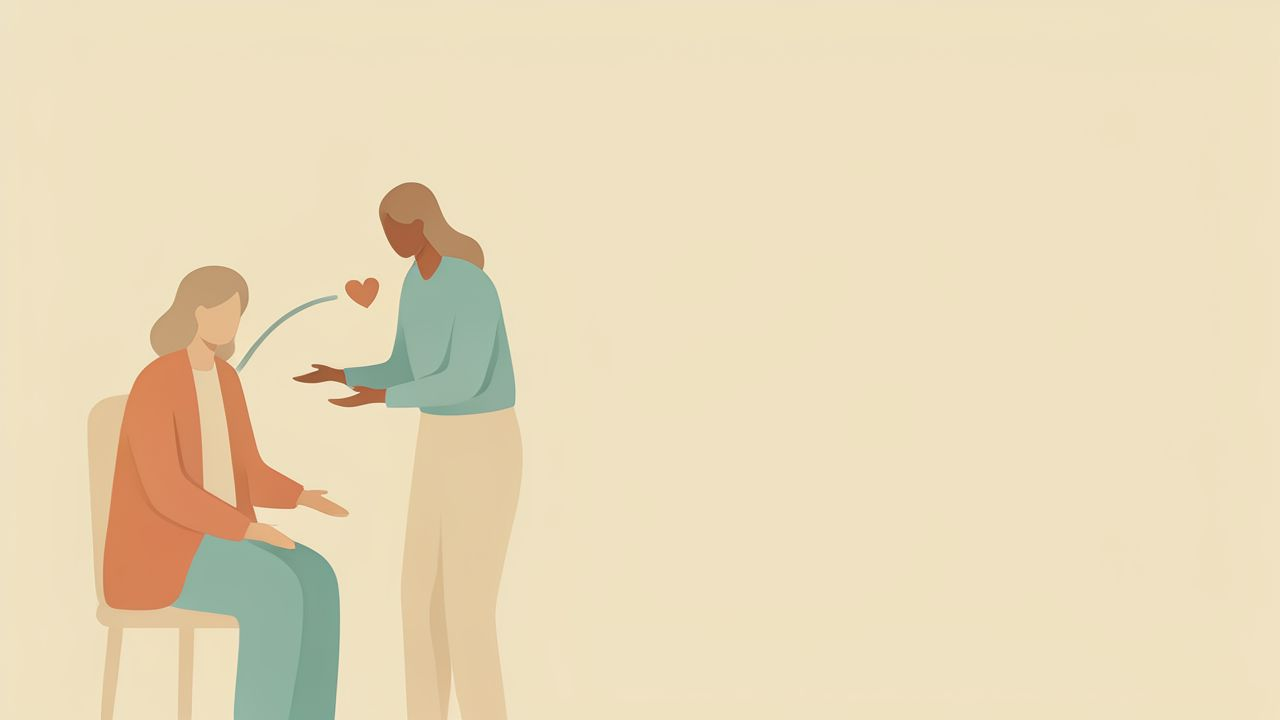
Around 1.8 million people in Germany live with dementia, and the German Alzheimer Society expects the figure to reach roughly 2.8 million by 2050 as the population ages. Most of them are cared for at home, which means that for care staff the dementia conversation is not a specialism but a daily event.
The language of that conversation is unusual. Its purpose is rarely to convey information and almost never to correct a mistake. German care training gives the approach a name, Validation, and a small set of working phrases that keep a person talking rather than withdrawing.
The Vocabulary the Sector Uses Now
The words around dementia changed as practice changed, and the older terms now sound wrong to a German care manager.
| Older wording | Current wording |
|---|---|
| aggressives Verhalten | herausforderndes Verhalten |
| verwirrt | orientierungsgestört |
| dementer alter Mensch | Mensch mit Demenz |
| Beschäftigung | Tagesstruktur und Aktivierung |
| Pflegefall | Mensch mit Unterstützungsbedarf |
Herausforderndes Verhalten, challenging behaviour, is the term you will see written in a care plan. It frames the behaviour as communication rather than as a symptom, and the measures that follow from it are correspondingly different.
What Validation Actually Asks You to Do
Validation was developed by Naomi Feil and is standard practice in German dementia care. Its core move is to accept the reality a person is expressing and explore it, rather than correcting it.
| Approach | What it looks like in German |
|---|---|
| accept the feeling | "Sie machen sich Sorgen um Ihre Mutter." |
| ask about the content | "Erzählen Sie mir von Ihrer Mutter." |
| join the reality | "Sie wartet sicher schon auf Sie." |
| avoid contradiction | do not correct a factual error |
| move with the emotion | follow the feeling, not the fact |
Correcting a person with dementia is not a neutral act. It produces the experience of being wrong, which produces withdrawal or distress, which then gets recorded as challenging behaviour.
What Families Ask, and What to Answer
| Question | German answer |
|---|---|
| "Warum erkennt sie mich nicht mehr?" | "Das Erkennen kommt und geht bei Demenz." |
| "Ist das noch normal?" | "Das ist eine typische Veränderung im Verlauf." |
| "Soll ich sie korrigieren?" | "Besser ist es, das Gefühl aufzunehmen." |
| "Wie lange geht das noch?" | "Der Verlauf ist sehr unterschiedlich." |
| "Kann sie noch zu Hause bleiben?" | "Das hängt von der Unterstützung ab." |
Relatives ask the same five questions in every country, and German has settled, non-alarming answers for each of them. The fourth is the one families find hardest to accept, because medicine does not offer a timeline and the honest answer is that the course varies from a couple of years to well over a decade.
When You Cannot Follow the Reality
| Situation | What helps in German |
|---|---|
| a statement you cannot agree with | "Das klingt, als wäre es schwer für Sie." |
| a repeated question | answer, then offer a drink or a short walk |
| a person who will not sit down | walk with them first |
| a person who is frightened | lower your voice and your height |
| a person who is silent | sit nearby and do something visible |
Validation is not a script that can be followed every time, and German training acknowledges that openly. When agreement is impossible, the fallback is to acknowledge the feeling without confirming the fact, which is why the sentence above opens with "Das klingt" rather than with "Ja".
Reporting Behaviour Without Labelling the Person
| Weak entry | Strong entry |
|---|---|
| "Herr M. ist aggressiv" | "Herr M. schlägt um sich, wenn er beim Waschen berührt wird." |
| "Frau S. ist verwirrt" | "Frau S. findet ihr Zimmer abends nicht." |
| "ständige Rufe" | "Herr K. ruft alle fünf Minuten nach seiner Frau." |
| "verweigert alles" | "Frau B. lehnt das Waschen ab, nimmt aber das Essen an." |
| "Weglauftendenz" | "Frau L. geht am Nachmittag Richtung Ausgang." |
Every one of those rewrites does the same thing: it replaces a judgement with an observation. German care documentation treats that as the difference between a record that supports a person and a record that labels them, and the difference is exactly what an audit looks for.
The rewriting exercise is also the fastest way to improve your German in this field, because it forces you to reach for the precise verb. "Schlägt um sich" describes an action; "aggressiv" classifies a person, and it tells the next shift nothing they can act on.
Phrases for Common Situations
These five situations account for a large share of difficult moments on a dementia unit.
| Situation | German phrase |
|---|---|
| wanting to leave | "Sie möchten nach Hause. Was erwartet Sie dort?" |
| asking for a relative who has died | "Erzählen Sie mir von ihm." |
| refusing care | "Sie möchten heute nicht. Was wäre Ihnen lieber?" |
| the same question again | answer again, then redirect to an activity |
| evening agitation | "Es ist unruhig heute. Setzen wir uns zusammen." |
The rule behind all five is that you answer the emotion and you do not contradict the content. Note that not one of these phrases contains a correction.
Structure, Memory and the Day
Two further concepts appear in nearly every German care plan for a person with dementia.
| German term | English meaning |
|---|---|
| die Tagesstruktur | the daily structure |
| die Aktivierung | activation, purposeful activity |
| die Erinnerungspflege | reminiscence work |
| die 10-Minuten-Aktivierung | a short, structured activity |
| das Orientierungstraining | orientation work |
| der Orientierungsverlust | loss of orientation |
Reminiscence work uses material from the person's own past, and in Germany it often means the years they grew up in rather than recent photographs. The 10-Minuten-Aktivierung is exactly what it sounds like: a short, repeatable activity that fits a person whose attention span is measured in minutes. Learning the phrases that go with it is a practical step rather than a sentimental one, and it is one of the best reasons to learn German for care work.
Working in German Dementia Care
Dementia-specific units exist in care homes and in day care, and there is a further qualification, the Weiterbildung zur gerontopsychiatrischen Fachkraft, taken after the basic care training. Dementia is also one of the main reasons a Pflegegrad is raised, so the assessment vocabulary and the care vocabulary reinforce each other.
At interview the scenario is usually the same: a resident insists that her husband is coming to collect her this evening, and he died some years ago. The answer marked correct is the one that follows the feeling rather than the fact. If you want to learn German for dementia care, practise the validating phrase before the clinical one, because it is the one you will use every shift.
The bars show the order of the approach; validation is a sequence, not a quantity, so the values are step numbers.
A validating sentence keeps a person in the conversation. Learn German with dementia care language, Tagesstruktur and everyday care vocabulary built into the course.
Put your German to work. The LanguageSkills German course is self-paced and built around real situations like these — you speak, and your AI tutor corrects you on the spot, from A1 to B2.