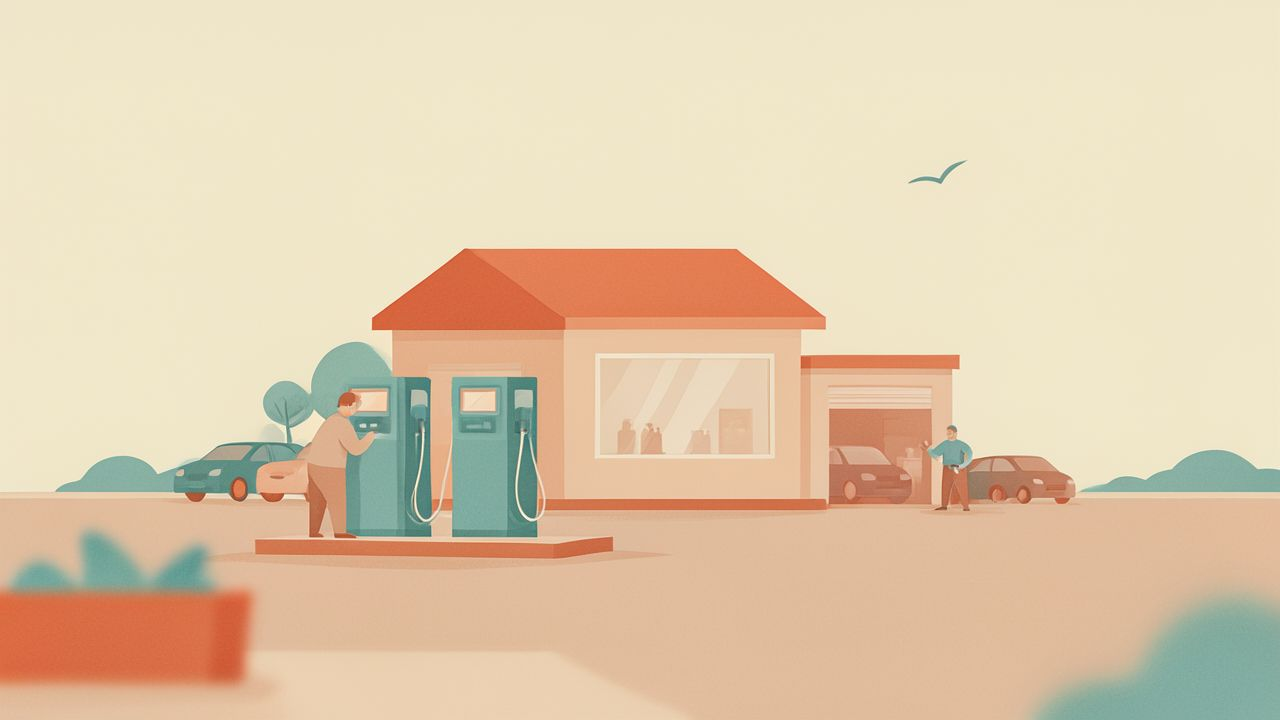
A Dutch petrol station is two businesses in one building: a forecourt that sells fuel by the litre, and a shop that sells coffee, snacks and essentials to people in a hurry. The staff serve both, often at the same moment.
The work is done with numbers and short phrases, and it runs through the whole day and night. What looks like a simple job is really a test of accuracy under time pressure, because the money on the forecourt is the employer's.
The Words of the Station
| Dutch term | English meaning |
|---|---|
| de tankstation | the petrol station |
| de pomp | the fuel pump |
| het vulpistool | the fuel nozzle |
| de brandstof | the fuel |
| de diesel | the diesel |
| de benzine | the petrol |
| de liter | the litre |
| de prijs | the price |
A Dutch forecourt has separate nozzles for petrol and diesel, and a misfuelling is expensive for the customer and awkward for the staff. Signs on the pomp state the price per litre, and in the Netherlands that price moves during the day rather than once a week.
Paying for Fuel
| Dutch term | English meaning |
|---|---|
| de kaartbetaling | the card payment |
| de contante betaling | the cash payment |
| de tankpas | the fuel card |
| de bon | the receipt |
| de kwitantie | the till receipt |
| de factuur | the invoice |
| de zelfbediening | the self-service |
| de cassiere | the cashier |
Most Dutch drivers pay at the till or at the pump, and company cars settle by tankpas against a monthly account. The bon is a document rather than a souvenir, because many customers reclaim the fuel as a business expense.
The Shop and the Range
| Dutch term | English meaning |
|---|---|
| het assortiment | the range |
| de snack | the snack |
| de drank | the drink |
| het tijdschrift | the magazine |
| de tabak | the tobacco |
| de koeling | the chiller |
| het statiegeld | the returnable deposit |
| de koffie to go | the takeaway coffee |
The shop range is chosen for the number of cars passing rather than for the neighbourhood, and the margin sits in coffee and snacks rather than in fuel. The statiegeld system means bottles come back, and the deposit is refunded at the till.
Fresh Food and Coffee
| Dutch term | English meaning |
|---|---|
| het broodje | the filled roll |
| de koffie | the coffee |
| de machine | the machine |
| het gebak | the pastry |
| de hygiene | the hygiene |
| de houdbaarheid | the shelf life |
| de temperatuur | the temperature |
| de THT-datum | the best-before date |
Coffee is the product that decides whether a Dutch station makes money, so the machine is cleaned on a fixed schedule and the milk is checked daily. Food safety rules apply exactly as they do in a cafe, and the temperature log is inspected.
The Forecourt
| Dutch term | English meaning |
|---|---|
| de wasstraat | the car wash |
| de wasinstallatie | the wash installation |
| de stofzuiger | the vacuum cleaner |
| de luchtpomp | the air pump |
| de bandenspanning | the tyre pressure |
| de ruitenwisservloeistof | the screen wash |
| de AdBlue | the AdBlue |
| de werkplaats | the workshop |
The forecourt includes a car wash, a vacuum, air and water, and each of them is a small business of its own with its own prices and faults. When a machine breaks down the sign must be put out at once, because a customer who pays for a wash that fails will complain.
Daily Work and Shifts
| Dutch term | English meaning |
|---|---|
| de dienst | the shift |
| de nachtdienst | the night shift |
| de overdracht | the handover |
| het vakkenvullen | the shelf filling |
| de netheid | the cleanliness |
| de leverancier | the supplier |
| de inventarisatie | the stocktake |
| de afrekening | the till reconciliation |
A Dutch petrol station runs around the clock, so shifts include nights, weekends and public holidays, and the night supplement is a real part of the pay. The overdracht between shifts counts the till and the stock, and a difference must be explained before the next shift starts.
Safety and Rules
| Dutch term | English meaning |
|---|---|
| het rookverbod | the smoking ban |
| de brandveiligheid | the fire protection |
| de brandblusser | the fire extinguisher |
| de omgang met brandstof | the handling of fuel |
| de leeftijdscontrole | the age check |
| het verbod | the prohibition |
| het toezicht | the supervision |
| de beveiligingscamera | the security camera |
Fuel is a hazardous substance, so smoking, phones at the pomp and running engines are regulated in detail. Alcohol and tobacco sales require an leeftijdscontrole, and selling to a minor is an offence that can close the station.
Pay, Contracts and Progression
| Dutch term | English meaning |
|---|---|
| de cao | the collective agreement |
| de nachttoeslag | the night supplement |
| de zondagstoeslag | the Sunday supplement |
| de deeltijd | the part-time work |
| de oproepkracht | the on-call worker |
| de ploegleider | the shift leader |
| het dienstverband | the employment relationship |
| de bijscholing | the further training |
Dutch petrol station pay is often set by a sector cao, and the night, Sunday and holiday supplements make up a large part of a full-time income. Because the station never closes, the rota is planned a month ahead.
Many employees work part-time, and students are common behind the till in the evenings and at weekends. Oproepkrachten are paid by the hour and receive the same supplements in proportion to the diensten they work.
The route onwards leads to ploegleider, then to station manager, because a station is a small business with its own figures, stock and staff. Length of service matters, and the dienstverband often decides who is offered the next step.
Dutch petrol stations also employ staff for the car wash, the werkplaats and the coffee bar, each with its own rate of pay and its own training. If you want to serve a customer at the pomp or the till in Dutch, learn Dutch with the petrol station vocabulary built into the course.
The bars show the order of the stages; each value is a sequence number rather than a duration.
Working at a Petrol Station in the Netherlands
A petrol station is one of the easiest first jobs in the Netherlands, because the training is short and the shifts are always available. The language needed is a set of fixed phrases about fuel, payment and the shop, repeated until they are automatic.
Accuracy and honesty matter more than fluency here, but the words still have to be exact. If you want to learn Dutch for customer-facing work, the petrol station vocabulary is a useful and quick first step.
Dutch petrol station work runs on numbers, short phrases and a clean forecourt. Learn Dutch with fuel, payment and shop language built into the course.
Put your Dutch to work. The LanguageSkills Dutch course is self-paced and built around real situations like these — you speak, and your AI tutor corrects you on the spot, from A1 to B2.