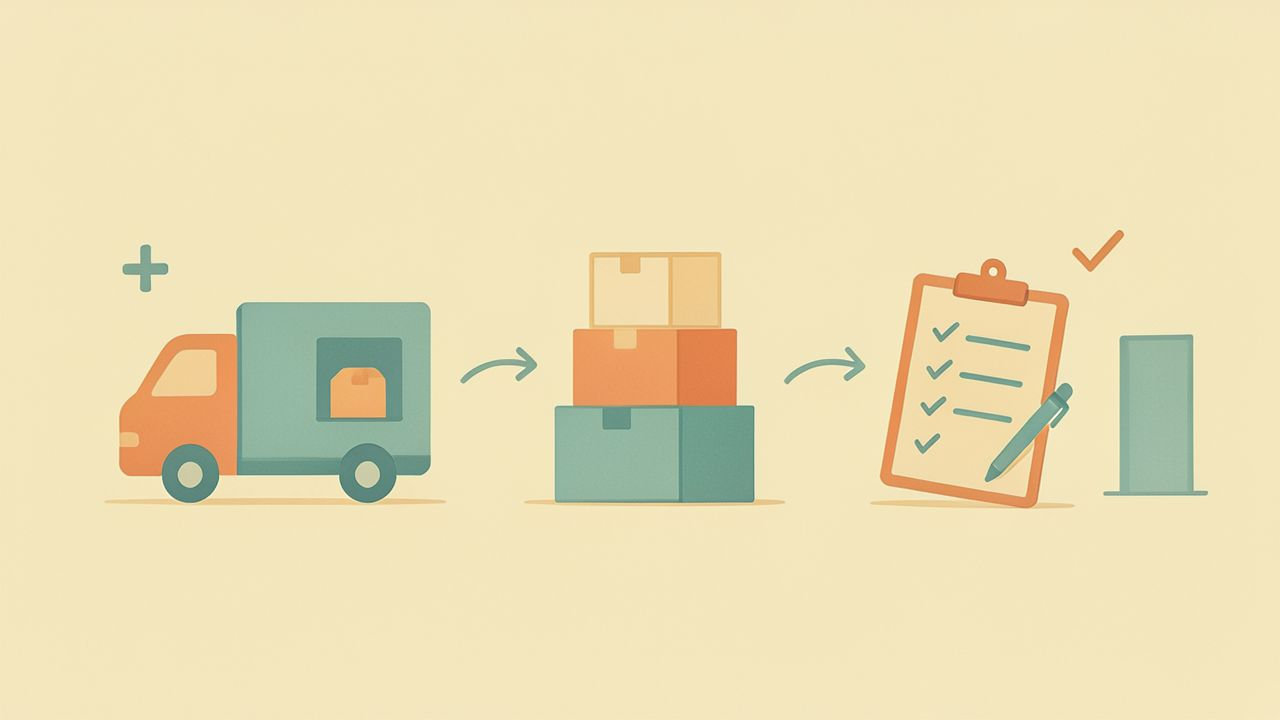
Every product in a Dutch warehouse or shop arrives through one door, and someone has to stand there and decide whether the delivery can be accepted. In the Netherlands that person works in goederenontvangst, and the job mixes counting, checking and writing things down.
The trade has its own words, and they are exact. A tekort is not the same as transportschade, and an overlevering is not a defect. Knowing the difference is what stops a company paying for goods it never received.
The Words of the Loading Bay
| Dutch term | English meaning |
|---|---|
| de goederenontvangst | the goods-in department |
| de levering | the delivery |
| de leverancier | the supplier |
| de pakbon | the delivery note |
| de loskade | the loading dock |
| de poort | the gate |
| het dock | the bay |
| de vrachtbrief | the consignment note |
A delivery arrives in a fixed tijdslot, a time window booked in advance, and the driver expects to be unloaded inside it. The clerk checks the paperwork first and the goods second, because a signature on the pakbon is what makes the company liable.
Checking a Delivery
| Dutch term | English meaning |
|---|---|
| het aantal | the number of items |
| het aantalverschil | the quantity discrepancy |
| het tekort | the shortfall |
| de overlevering | the excess delivery |
| de visuele controle | the visual inspection |
| de transportschade | the transport damage |
| de verpakking | the packaging |
| de breuk | the breakage |
The check follows a fixed order: count the pallets, count the boxes, open anything whose packaging looks damaged, and compare the total with the pakbon. Anything found is written on the note before the driver signs, and a photograph is taken.
The Delivery Note and the Paper Trail
| Dutch term | English meaning |
|---|---|
| de factuur | the invoice |
| het bestelnummer | the order number |
| de bon | the receipt |
| het aftekenen | the signing off |
| de handtekening | the signature |
| de stempel | the stamp |
| het verschil | the discrepancy |
| het dossier | the file |
The pakbon links what arrived to what was ordered, and the order number on it must match the internal bestelnummer. A signature given without a note of the damage is hard to undo later, which is why the clerk records every deviation before the lorry leaves.
Booking the Goods In
| Dutch term | English meaning |
|---|---|
| het voorraadsysteem | the stock management system |
| de goederenboeking | the goods receipt posting |
| de scanner | the hand scanner |
| de barcode | the barcode |
| de partij | the batch |
| het serienummer | the serial number |
| de houdbaarheidsdatum | the best-before date |
| de THT-datum | the minimum shelf life date |
Once the goods are accepted they are booked into the system, and the partij and the houdbaarheidsdatum decide where the pallet is stored. A wrong booking is worse than a missing one, because it makes the stock figures wrong for months.
Rejecting and Returning
| Dutch term | English meaning |
|---|---|
| de klacht | the complaint |
| de weigering | the rejection of a delivery |
| de retourzending | the return shipment |
| de retourbon | the return note |
| de creditnota | the credit note |
| de vervangende levering | the replacement delivery |
| het schaderapport | the damage report |
| de fotodocumentatie | the photographic record |
A whole delivery is refused only when the defect is fundamental, and otherwise the damaged items are separated and a creditnota is requested. If you want to learn Dutch for this work, the vocabulary of refusal and credit is the part that saves your employer money.
Storage and Put-Away
| Dutch term | English meaning |
|---|---|
| de opslag | the put-away, the storage |
| de opslagplaats | the storage location |
| het rek | the shelving |
| de pallet | the pallet |
| de heftruck | the forklift |
| de koeling | the chilled storage |
| de opslag gevaarlijke stoffen | the dangerous goods store |
| de voorraadtelling | the stocktake |
Put-away follows the rules of the warehouse rather than the preference of the driver, and chilled or hazardous goods go to their own areas at once. The system suggests a location and the clerk confirms it with the scanner, so the stock figure and the shelf agree.
Working with Drivers and Suppliers
| Dutch term | English meaning |
|---|---|
| de chauffeur | the driver |
| de wachttijd | the waiting time |
| het tijdslot | the time slot |
| de aanmelding | the registration at the gate |
| de portier | the gatekeeper |
| de prioriteit | the priority |
| de spoedlevering | the express delivery |
| de blokkade | the blocked period |
A goods-in clerk meets drivers all day, and the conversation is short and practical: which dock, how long, which papers. When a delivery is late or incomplete, the polite phrase in Dutch is a question rather than an accusation, and that habit keeps the relationship with the supplier workable.
Equipment, Safety and Daily Targets
| Dutch term | English meaning |
|---|---|
| de palletwagen | the pallet truck |
| de heftruck | the forklift |
| de handscanner | the handheld scanner |
| de beschermende kleding | the protective clothing |
| de veiligheidsschoenen | the safety shoes |
| het veiligheidshesje | the high-visibility vest |
| de KPI | the key figure |
| de doorlooptijd | the throughput time |
A goods-in clerk works with a pallet truck, a forklift and a handheld scanner all day, and the right equipment decides how quickly a lorry can be turned around. Most Dutch sites require safety shoes, a high-visibility vest and gloves from the very first shift.
Every dock carries a target for the doorlooptijd, the time from arrival to put-away, and that figure is reviewed daily. A clerk who understands why the number matters can explain a delay in the right words instead of inventing a reason.
Accidents and near misses must be reported, because the Dutch insurers require a written record and a short investigation. Reporting a small incident early is treated as professional behaviour, not as an admission of clumsiness. If you want to read the pakbon and the schaderapport yourself, learn Dutch with the goods-in vocabulary built into the course.
The bars show the order of the stages; each value is a sequence number rather than a duration.
Working in Goods Inwards in the Netherlands
Goods-in work is one of the easiest doors into a Dutch logistics career, because the job is taught on site and the vocabulary is small and repeatable. Employers look for care with numbers and a willingness to write things down, not for perfect grammar.
The words that carry the job are the ones on the pakbon, the scanner and the schaderapport. If you want to learn Dutch for the loading bay, the vocabulary is limited enough to master in a few weeks of steady practice.
Goods-in work in the Netherlands is a job of counting, checking and recording. Learn Dutch with the delivery, damage and booking language built into the course.
Put your Dutch to work. The LanguageSkills Dutch course is self-paced and built around real situations like these — you speak, and your AI tutor corrects you on the spot, from A1 to B2.