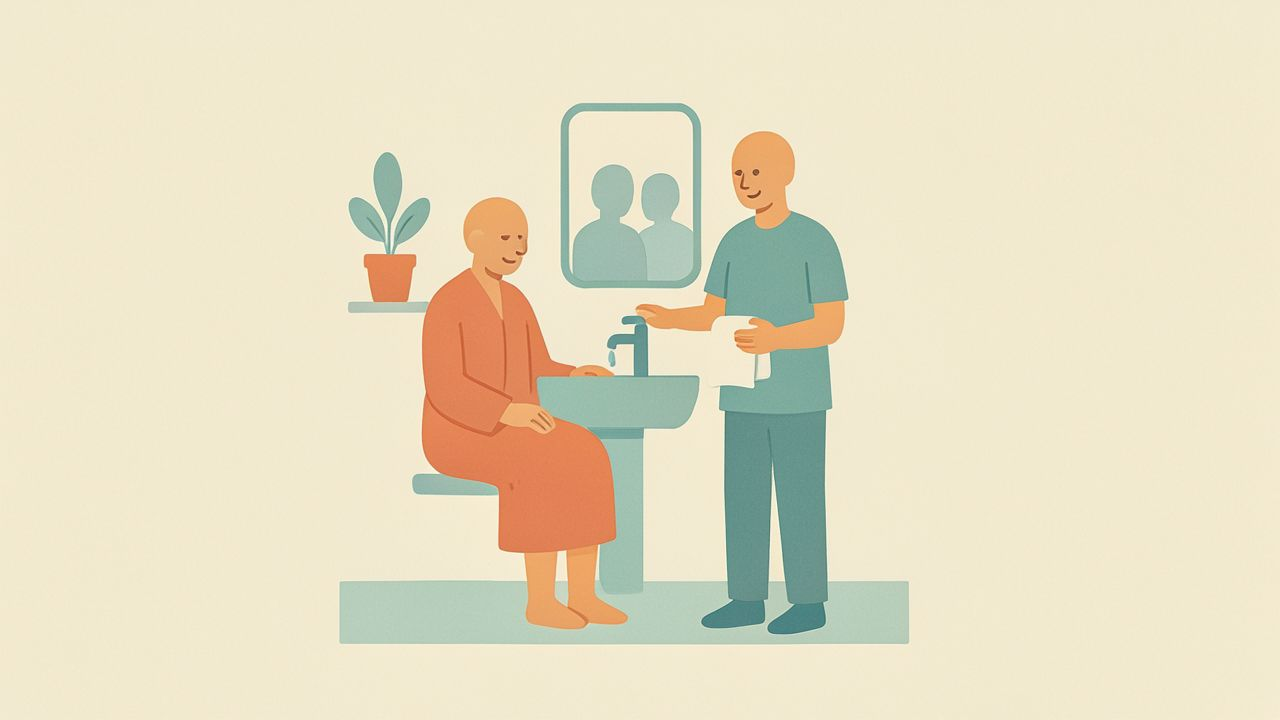
Morning hygiene is the most repeated task on any ward, and in Germany it is also one of the most language-heavy. It is intimate, it involves touching, and it is the moment when a patient's dignity is most exposed. Every word you say is doing privacy work as well as practical work.
This guide walks through the whole routine the way it actually happens, with the phrases German nurses use at each step. Read it once, then say it out loud, in order, until it runs without effort.
The Vocabulary of Basic Care
| German | English |
|---|---|
| die Körperpflege | personal hygiene care |
| die Grundpflege | basic care |
| das Waschwasser | the washing water |
| der Waschlappen | the flannel |
| das Handtuch | the towel |
| der Waschwagen | the washing trolley |
| die Intimsphäre | the intimate zone, personal privacy |
| die Sichtschutz | the privacy screen |
| die Hautpflege | skin care |
| die Einmalhandschuhe | disposable gloves |
If morning care is the part of your shift you dread in German, learn German by rehearsing the routine rather than by reading word lists.
Before You Start: Announcing and Preparing
German care practice is explicit about announcing yourself, and patients expect it. Skipping it reads as a lack of respect rather than as efficiency.
"Guten Morgen, ich bin Ihre Pflegekraft für heute." - Good morning, I am your nurse for today.
"Ich möchte Ihnen beim Waschen helfen. Ist das jetzt recht?" - I would like to help you wash. Is now a good time?
"Ich ziehe den Sichtschutz zu." - I am closing the privacy screen.
"Ich hole frisches Wasser und Handtücher." - I am getting fresh water and towels.
"Können wir anfangen, oder möchten Sie noch kurz warten?" - Shall we start, or would you like to wait a moment?
The Washing Sequence
Working in this order keeps the patient covered as much as possible. Announce each step before you begin it. Say the whole sequence out loud until it runs on its own - that is how you learn German for morning care.
| Step | German you say |
|---|---|
| 1 Face and hands | "Ich fange mit dem Gesicht an." |
| 2 Upper body | "Jetzt hebe ich Ihren Arm ein wenig an." |
| 3 Chest and abdomen | "Ich decke Sie kurz auf, damit ich an den Bauch komme." |
| 4 Intimate area | "Jetzt kommen wir zum Intimbereich. Sagen Sie mir bitte, wenn ich langsamer machen soll." |
| 5 Legs and feet | "Ich wasche jetzt Ihre Beine. Ist das Wasser noch warm genug?" |
| 6 Back | "Ich möchte Sie kurz auf die Seite drehen. Bitte halten Sie sich am Bettgitter fest." |
Phrases That Protect Dignity
These sentences are the reason the routine works. They give the patient control over a situation where they have very little.
"Ich decke Sie jetzt zu." - I am covering you now.
"Sagen Sie mir bitte, wenn es Ihnen zu viel wird." - Please tell me if it becomes too much.
"Ich mache das in Ihrem Tempo." - I am doing this at your pace.
"Sie können den Rest gerne allein machen, wenn Sie möchten." - You are welcome to do the rest yourself if you prefer.
"Ich schaue kurz weg." - I am looking away for a moment.
"Es ist alles in Ordnung. Nehmen Sie sich Zeit." - Everything is fine. Take your time.
Moving a Patient Safely
| German | English |
|---|---|
| "Können Sie sich selbst aufsetzen?" | Can you sit up by yourself? |
| "Bitte halten Sie sich am Bettgitter fest." | Please hold on to the side rail. |
| "Wir machen das zusammen auf drei." | We will do this together on three. |
| "Ich setze Sie jetzt hoch." | I am sitting you up now. |
| "Bitte nicht selbst aufstehen." | Please do not get up yourself. |
| "Ich habe Sie." | I have got you. |
The Grammar You Are Actually Using
Three patterns carry almost the whole routine.
The polite imperative with Sie. "Heben Sie bitte den Arm an." Notice the separable verb: the prefix an travels to the end.
The modal verb for consent. "Können wir anfangen?" and "Sollen wir eine Pause machen?" Asking rather than telling is what makes German care language feel respectful.
The present tense with jetzt. "Ich decke Sie jetzt zu." German uses the present for what is happening right now far more than English does, and the word jetzt does the signalling.
A Full Run-Through, Out Loud
Read this once, then say it without looking. It is a morning routine from the doorway to finished care.
"Guten Morgen, Frau Müller. Ich bin Ihre Pflegekraft für heute. Ich möchte Ihnen beim Waschen helfen - ist das jetzt recht? Ich ziehe den Sichtschutz zu und hole frisches Wasser. Ich fange mit dem Gesicht an. Jetzt hebe ich Ihren Arm ein wenig an. Ich decke Sie kurz auf, damit ich an den Bauch komme. Jetzt kommen wir zum Intimbereich. Sagen Sie mir bitte, wenn ich langsamer machen soll. Ich wasche jetzt Ihre Beine. Ist das Wasser noch warm genug? Ich möchte Sie kurz auf die Seite drehen. Bitte halten Sie sich am Bettgitter fest. So, wir sind fertig. Ich decke Sie zu und ziehe den Sichtschutz wieder auf."
That is roughly ninety seconds of German, and it covers the whole routine. If you can deliver it without searching for a word, you can work a German ward.
Three Mistakes Worth Avoiding
Using du with a patient. It is never correct, at any age, in any ward. Use Sie and the surname throughout, including during intimate care.
Narrating nothing. Silence during washing feels efficient to you and invasive to the patient. In German care, you are expected to say each step out loud.
Rushing the intimate area. Slow down, announce it, and offer the patient the option to do it themselves. This is one of the clearest differences between a competent carer and a trusted one.
Making It Fluency
Everything above happens in the first twenty minutes of an early shift, every single day. That is an enormous amount of repetition, which means it is also the fastest place for your German to become automatic - if you have practised the sentences before you need them.
Want your morning routine in German to run without thinking? Learn German with an AI tutor that roleplays morning care, step by step, at languageskills.net.
Put your German to work. The LanguageSkills German course is self-paced and built around real situations like these — you speak, and your AI tutor corrects you on the spot, from A1 to B2.