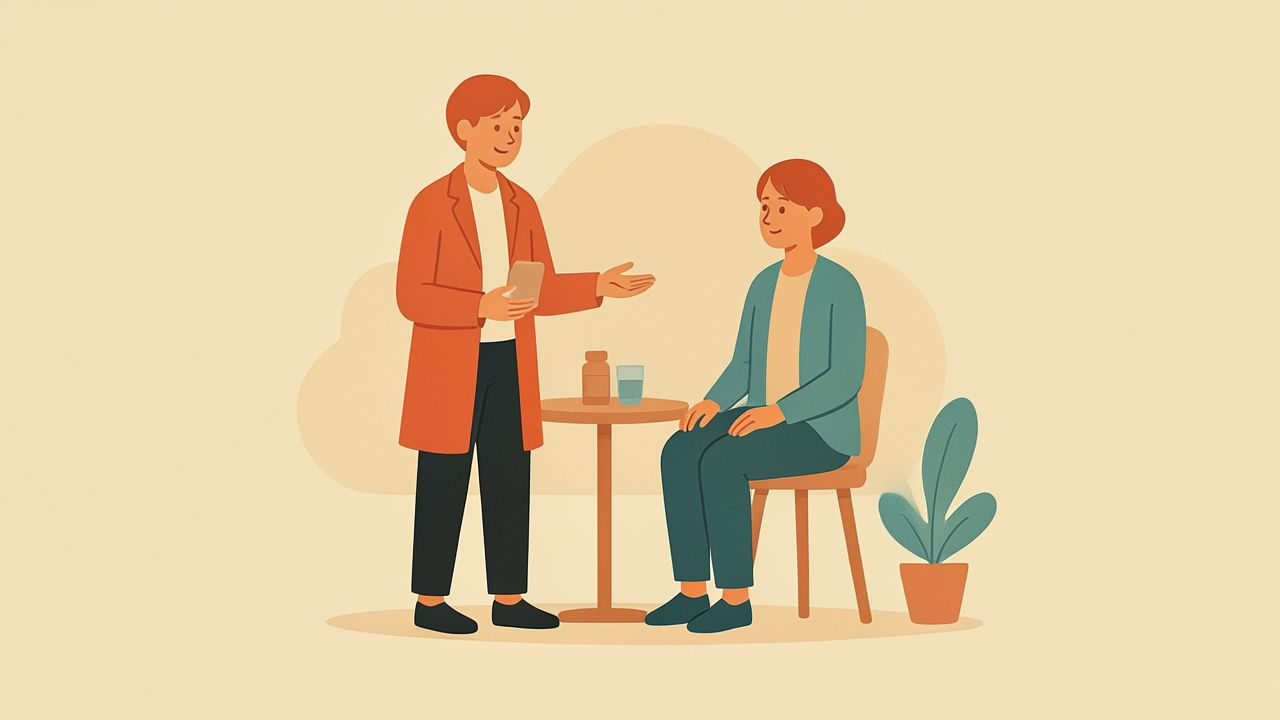
Explaining a medication to a patient is one of the highest-stakes conversations in nursing. In German it is also one of the most formulaic, which is good news: once you know the patterns, you can handle almost any drug on the ward.
This guide covers the units, the grammar and the exact phrases German nurses use when they hand a patient a tablet, an inhaler or a syringe.
The Three Things Every Patient Needs to Know
A complete German medication instruction answers three questions. German nursing training treats these as the minimum information a patient must receive before you leave the room.
Wie viel? - how much (die Dosis)
Wie oft? - how often (die Häufigkeit)
Wie lange? - for how long (die Dauer)
If you can deliver those three in German without hesitating, you have covered both the legal and the human basics. If you cannot yet, this is one of the highest-value things to practise when you learn German for clinical work.
Units and Abbreviations on a German Medication Plan
| Abbreviation | German | English |
|---|---|---|
| mg | Milligramm | milligram |
| g | Gramm | gram |
| ml | Milliliter | millilitre |
| µg | Mikrogramm | microgram |
| IE | Internationale Einheit | international unit (insulin, heparin, vitamins) |
| Tbl. | Tablette | tablet |
| Kps. | Kapsel | capsule |
| Tr. | Tropfen | drops |
| Hub | Hub | puff (inhalers and nasal sprays) |
| Zäpfchen | Suppositorium | suppository |
| Salbe | Salbe | ointment |
| Creme | Creme | cream |
Be careful with IE. Said casually it can be misheard, and international units are not interchangeable with milligrams. Say "Internationale Einheit" in full the first time, then use IE.
The 1-0-1 Grid: How German Medication Plans Are Written
German medication plans rarely write "twice daily" in words. They use a four-slot grid: morning, midday, evening and night. Each slot gets a number, and a zero means no dose.
| Medication | Morning | Midday | Evening | Night | What it means |
|---|---|---|---|---|---|
| Ramipril 5 mg | 1 | 0 | 1 | 0 | one tablet morning and evening |
| Metformin 1000 mg | 1 | 1 | 1 | 0 | three times a day, with meals |
| Simvastatin 20 mg | 0 | 0 | 1 | 0 | once in the evening |
| Levothyroxin 50 µg | 1 | 0 | 0 | 0 | once in the morning, fasting |
| Novalgin 500 mg | 0 | 0 | 0 | 0 | only as needed (bei Bedarf) |
Reading this grid aloud to a patient is a skill in itself. A German nurse would say: "Ramipril nehmen Sie morgens und abends eine Tablette."
Saying How Often, in German
| German | English meaning |
|---|---|
| einmal täglich | once a day |
| zweimal täglich | twice a day |
| alle acht Stunden | every eight hours |
| bei Bedarf | as needed |
| nüchtern | on an empty stomach |
| zu den Mahlzeiten | with meals |
| vor dem Essen | before the meal |
| nach dem Essen | after the meal |
| zur Nacht | at bedtime |
| im Wechsel | alternating |
The Grammar That Makes It Sound Native
Three structures carry almost all medication instructions in German.
The polite imperative. "Nehmen Sie die Tablette nach dem Frühstück." Using Sie plus the verb-first form is the standard, and it never sounds rude.
The passive for written instructions. "Die Tabletten werden morgens eingenommen." You will meet this far more often on packaging and in documentation than in speech.
The Konjunktiv II for advice. "Sie sollten die Tropfen langsam in die Backentasche geben." Sollten softens a recommendation into something a patient can accept rather than resist.
A simple rule of thumb: the imperative for speaking, the passive for writing, Konjunktiv II for anything a patient might refuse.
Safety Warnings German Patients Expect to Hear
These sentences turn a dosage instruction into safe practice.
"Bitte im Ganzen schlucken, nicht zerkauen." - Please swallow whole, do not chew.
"Nicht mörsern." - Do not crush. Critical for retard tablets.
"Vor Gebrauch schütteln." - Shake before use.
"Wenn Sie eine Dosis vergessen haben, nehmen Sie sie nicht doppelt." - If you miss a dose, do not double it.
"Melden Sie sich sofort, wenn Sie Nebenwirkungen bemerken." - Report side effects immediately.
Explaining the Why
Patients follow instructions far better when they understand the Wirkung, the effect, and the possible Nebenwirkung, the side effect. A short explanation in German is usually enough.
"Das Mittel senkt den Blutdruck." - The medicine lowers blood pressure.
"Es kann sein, dass Ihnen schwindelig wird." - You may feel dizzy.
"Das Medikament wirkt in etwa einer halben Stunde." - The medicine takes effect in about half an hour.
"Das ist ein Retardtablette, sie wirkt über zwölf Stunden." - This is a slow-release tablet, it works over twelve hours.
Watch for Wechselwirkungen, interactions. If a patient asks about something they bought themselves at the pharmacy, that is the word you need.
Three Mistakes Worth Avoiding
Speaking too fast through the numbers. In German, "zwanzig" and "siebzig" are easily confused even for native speakers on a noisy ward. Slow down on every dose.
Using Latin abbreviations with patients. Say Zäpfchen, not "Supp.". Patients do not read Latin, and they will not ask you to repeat it.
Forgetting the leaflet. The Packungsbeilage must be supplied, and pointing to it is part of the conversation, not an optional extra.
Turning Recognition Into Fluency
You can recognise every word in this article and still freeze when a patient asks "Und was mache ich, wenn ich es vergesse?" That question needs a spoken answer, immediately, with a person waiting in front of you.
That is why the medication module at languageskills.net is built around speaking rather than clicking. You learn German by practising the exact exchange - nurse, patient, dosage, question, answer - until it becomes automatic.
Want to rehearse this conversation with an AI patient before your next shift? Learn German at languageskills.net.
Put your German to work. The LanguageSkills German course is self-paced and built around real situations like these — you speak, and your AI tutor corrects you on the spot, from A1 to B2.