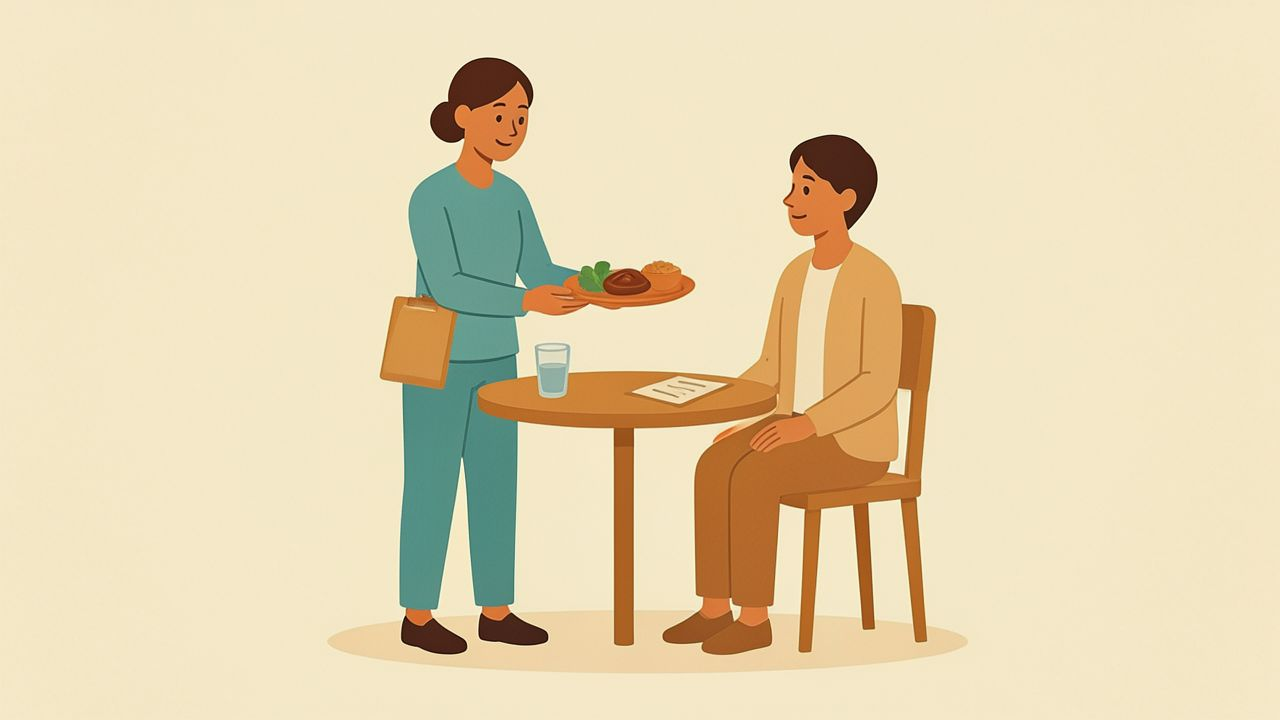
Telling a patient with diabetes what to eat is one of the few conversations in nursing where the language itself carries the treatment. Get the words wrong and the patient eats the wrong thing. Get them right and nothing else is needed.
German diabetes education has its own vocabulary, its own units and its own tone. This guide covers all three.
The Core Vocabulary
| German | English |
|---|---|
| der Diabetes | diabetes |
| der Blutzucker | blood glucose |
| das Insulin | insulin |
| die Unterzuckerung | hypoglycaemia, low blood sugar |
| die Überzuckerung | hyperglycaemia, high blood sugar |
| die Kohlenhydrate | carbohydrates |
| die Ballaststoffe | dietary fibre |
| das Vollkornbrot | wholemeal bread |
| das Gemüse | vegetables |
| das Obst | fruit |
| die Süßigkeiten | sweets |
| die Mahlzeit | meal |
| der Zwischenmahlzeit | snack |
| das Sättigungsgefühl | feeling of fullness |
| das HbA1c | long-term blood glucose marker |
If you are preparing to work with German-speaking patients, learn German with clinical vocabulary taught in the situations where you will use it.
The Units: BE and KE
German diabetes education counts carbohydrate portions, and there are two competing units you will meet.
| Unit | German name | Carbohydrate per unit |
|---|---|---|
| BE | Broteinheit | 12 grams |
| KE | Kohlenhydrateinheit | 10 grams |
The Broteinheit is the older German convention and still appears in patient materials. The Kohlenhydrateinheit is more common in current clinical teaching. The two are different, they are not interchangeable, and mixing them up produces a real dosing error.
The safe sentence on a new ward is: "Rechnen wir hier mit BE oder mit KE?"
The Food Groups, in German
| German | English | Note for patients |
|---|---|---|
| Vollkornprodukte | wholegrain products | slower glucose rise |
| Hülsenfrüchte | pulses, legumes | high fibre, filling |
| Gemüse | vegetables | low carbohydrate load |
| Obst | fruit | contains fructose, count it |
| Milchprodukte | dairy products | note the lactose |
| Fette und Öle | fats and oils | no direct glucose effect |
| Zucker und Süßigkeiten | sugar and sweets | fast glucose rise |
| Alkohol | alcohol | can cause delayed lows |
How to Phrase the Advice
German nutrition advice is notably direct, and softening it too much makes you sound unsure. Three patterns carry almost everything.
Sollten for recommendation. "Sie sollten Vollkornbrot statt Weißbrot wählen." The Konjunktiv II form sollten is the standard way to advise without commanding.
The imperative for concrete instructions. "Essen Sie nicht direkt vor dem Schlafengehen." Clear and appropriate.
Je ... desto for consequences. "Je mehr Ballaststoffe Sie essen, desto langsamer steigt der Blutzucker." This structure is common in German patient education and worth mastering.
Twenty Sentences You Will Use
"Zählen Sie die Kohlenhydrate bei jeder Mahlzeit." - Count the carbohydrates at every meal.
"Wählen Sie Vollkorn statt Weißmehl." - Choose wholegrain instead of white flour.
"Achten Sie auf versteckten Zucker in Getränken." - Watch for hidden sugar in drinks.
"Essen Sie regelmäßig, nicht nur einmal am Tag." - Eat regularly, not just once a day.
"Vermeiden Sie zuckerhaltige Limonaden." - Avoid sugary soft drinks.
"Trinken Sie ausreichend Wasser." - Drink enough water.
"Alkohol kann später zu einer Unterzuckerung führen." - Alcohol can lead to low blood sugar later.
"Halten Sie immer Traubenzucker bereit." - Always keep glucose tablets with you.
"Bei Zittern, Schwitzen oder Heißhunger sofort etwas essen." - Eat something immediately if you shake, sweat or feel ravenous.
"Bewegen Sie sich nach dem Essen." - Move around after eating.
An illustrative ranking, not a clinical table. It is the shape of the message rather than the numbers that patients need.
Recognising a Low, in German
Half of diabetes teaching is teaching the patient to notice a hypo. The German symptoms are worth learning as a set, because patients will report them in exactly these words.
"Ich zittere." - I am shaking.
"Mir ist schwindelig." - I am dizzy.
"Ich schwitze plötzlich." - I am suddenly sweating.
"Ich habe Heißhunger." - I am ravenous.
"Ich bin plötzlich verwirrt." - I am suddenly confused.
If a patient says any of these, the German response is immediate: "Sie haben eine Unterzuckerung. Essen Sie jetzt etwas."
Three Mistakes Worth Avoiding
Mixing BE and KE. Establish the ward convention before you teach anything, and never switch units mid-conversation.
Using Latin or English food terms. Patients cook with German words. Linsen, Kohl, Graupen and Quark are the vocabulary the advice depends on.
Frightening instead of enabling. German patients respond better to "So halten Sie Ihren Blutzucker stabil" than to a list of prohibitions. The goal is control, not restriction.
Handling the Questions Patients Actually Ask
German diabetic patients ask the same handful of questions, and having an answer ready is what separates a lecture from a conversation.
"Darf ich noch Brot essen?" - Yes, with a defined amount: "Ja, zwei Scheiben Vollkornbrot zum Frühstück." "Was ist mit Obst?" - Fruit is a carbohydrate source and must be counted, not forbidden: "Obst ist erlaubt, aber es zählt mit." "Muss ich auf Alkohol verzichten?" - No, but it interferes with glucose control, so the honest answer is "Alkohol senkt den Blutzucker, deshalb nur in Maßen und nie auf nüchternen Magen."
Answering these well is not a matter of knowing more medicine. It is a matter of knowing the German phrasing well enough to answer while the patient is still listening, which is exactly what it means to learn German for patient education.
Turning Knowledge Into Instruction
Everything above is knowledge. What patients need from you is instruction: spoken, clear, repeated, and delivered in a way they can act on the same evening.
Want to teach German-speaking patients confidently rather than recite rules? Learn German with patient-education roleplays at languageskills.net.
Put your German to work. The LanguageSkills German course is self-paced and built around real situations like these — you speak, and your AI tutor corrects you on the spot, from A1 to B2.