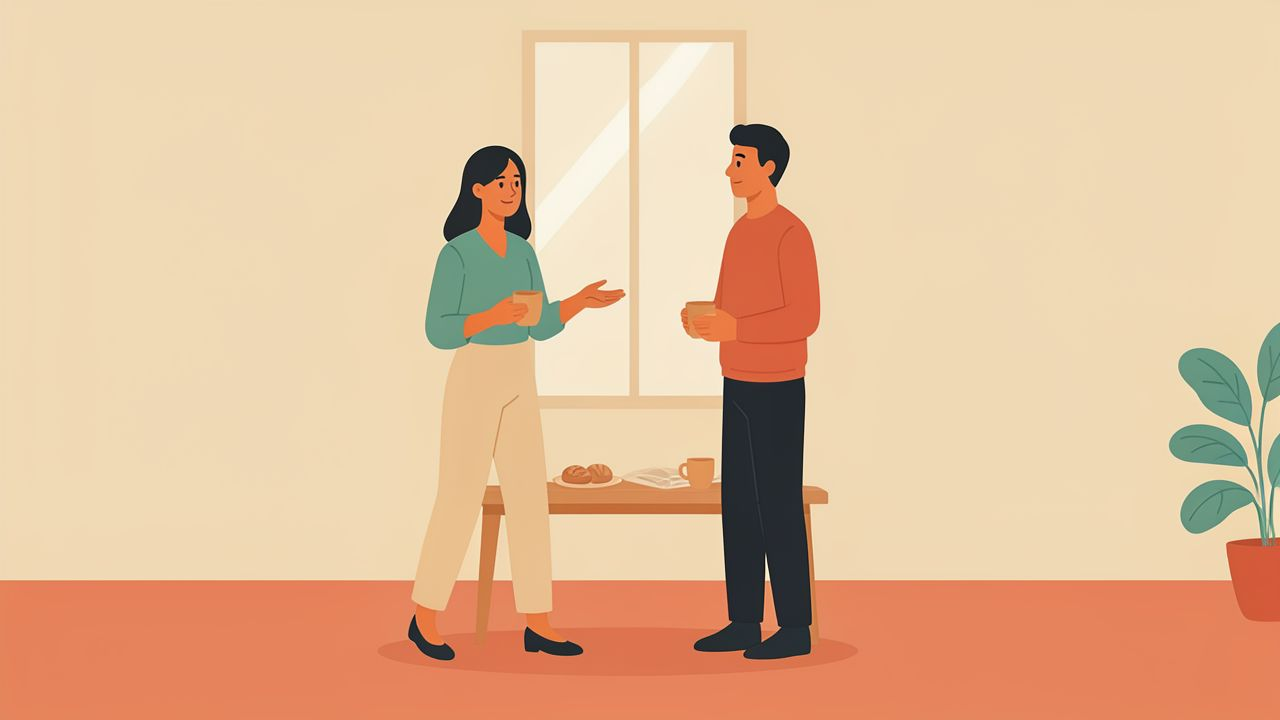
The German word Pausenraum means the break room, and it is where a new colleague stops being new. Job competence gets you the contract; fifteen minutes of competent small talk is what turns you from the person who works there into a colleague. German small talk has rules, and they are learnable.
The Words That Open Every Door
German workplaces have greeting conventions that courses rarely teach. Mahlzeit is used as a lunchtime greeting in canteens and break rooms across much of Germany, and it functions as both hello and enjoy your meal around midday. It is informal, universal and completely safe.
Regional greetings matter more than you might think. Moin works in northern Germany at any hour of the day, not only in the morning. Servus or Grüß Gott is standard in Bavaria and Austria, and Servus doubles as a farewell. Tschüss is the ordinary goodbye almost everywhere, with tschau and bis morgen as friendly variants. Using the local greeting is a small signal that you noticed where you are.
| German phrase | When to use it |
|---|---|
| Mahlzeit | midday, entering or passing the break room |
| Moin | northern Germany, any time of day |
| Servus, Grüß Gott | southern Germany and Austria |
| Tschüss, bis morgen | leaving, any region |
| Wie war's? | back at work after a day off or holiday |
| Schönes Wochenende | Friday afternoon, on leaving |
| Guten Appetit | starting a meal together |
Five Subjects That Always Work
German small talk runs on a short list of dependable subjects, and all of them are safe because none of them is personal. Weather is the universal opener. The weekend is the natural Monday question. Holidays, meaning Urlaub, are discussed in enormous detail, and asking where someone is going is a normal and welcome question rather than an intrusion.
Two more subjects are reliably productive. Football carries an hour of conversation in most German workshops, especially on a Monday after a Bundesliga matchday. And das Pendeln, the commute, is something every German employee has an opinion about, because transport reliability is shared daily experience.
| German phrase | What it means |
|---|---|
| Wie war dein Wochenende? | How was your weekend? |
| Und, schon Urlaubspläne? | Any holiday plans yet? |
| Bist du am Wochenende zum Fußball? | Are you at the football this weekend? |
| Wie kommst du zur Arbeit? | How do you get to work? |
| Das Wetter spielt verrückt. | The weather is going crazy. |
The Subjects Germans Do Not Discuss
German colleagues are notably private about a specific set of topics, and the boundary is firmer than in Britain or the United States. Gehalt, salary, is discussed rarely and never as an opening question. Krankheit, illness, is treated as private information rather than as conversational material, and a long absence is normally met with "Alles wieder gut?" and no follow-up.
Politics, religion and family arrangements are handled carefully in mixed company, and gossip about absent colleagues costs standing fast. The unwritten rule is that the break room is for things everyone can contribute to. If a subject would put a colleague in the position of explaining their private life, it belongs in a different room.
Coffee, the Kaffeekasse and Doing Your Share
The most important cultural object in a German workplace may be the Kaffeekasse: a tin beside the coffee machine into which everyone puts a small amount. It is a shared system that works only if everyone participates, and topping it up unprompted is one of the clearest signals that you understand how the place runs. It is also one of the first rituals worth understanding when you learn German for a German workplace.
The axis is a designed scale from one to five, where one is completely safe and five is a subject German colleagues avoid.
Invitations, Feierabend and the Company Outing
German working time is bounded by a word that has no clean English equivalent: Feierabend, the moment the working day is over. Once it is declared, work talk stops. If colleagues say "Wir gehen noch eins trinken", they are inviting you to the Feierabendbier, and accepting once matters more than accepting every time.
Larger social events follow a calendar you can plan around. A Betriebsausflug is the company outing, often a full day. A Weihnachtsfeier is the Christmas party, and it is normally the largest social event of the German working year. The Brückentag, a bridging day taken between a public holiday and the weekend, is one of the most discussed dates in any German office, and knowing the word makes the conversation easier.
Asking for Holiday Cover
Eventually you need something, and the request has its own vocabulary. Urlaubsvertretung means holiday cover, and the sentence that gets it is straightforward: "Ich habe Urlaub beantragt. Könntest du in der Zeit meine Aufgaben übernehmen?" Asking early is a professional norm in Germany, not an imposition, and colleagues who are asked in good time almost always agree.
Being able to make a request, receive an answer and thank someone appropriately in one short exchange is the whole point of small talk at work. It is not decoration on top of the job; it is how the job gets done, and it is exactly what people practise when they learn German for a German workplace.
Your German improves fastest in the fifteen minutes around the coffee machine. Learn German with workplace dialogues built for the Pausenraum, the Kaffeekasse and the Feierabend.
Put your German to work. The LanguageSkills German course is self-paced and built around real situations like these — you speak, and your AI tutor corrects you on the spot, from A1 to B2.