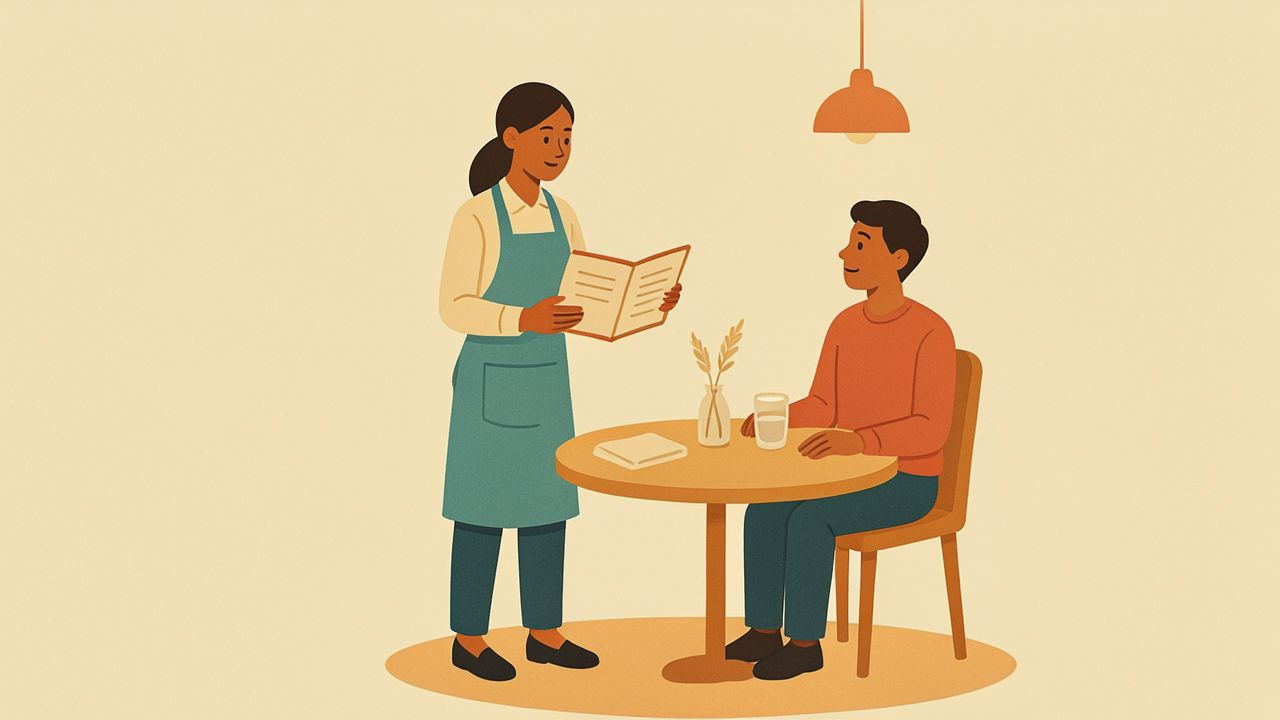
Service in a German restaurant is more discreet than in many countries, and the language reflects that. Guests expect attention without interruption, recommendations that are honest rather than enthusiastic, and a bill that arrives when they want it rather than when the kitchen is finished.
For a Servicekraft, that means learning a small number of sentences and using them accurately. German guests notice immediately when a server over-promises a dish or reads the specials from a sheet without knowing what is in them.
The Words of the Table
| German term | English meaning |
|---|---|
| die Speisekarte | the menu |
| die Getränkekarte | the drinks menu |
| die Tageskarte | the daily menu |
| die Vorspeise | the starter |
| der Hauptgang | the main course |
| die Nachspeise | the dessert |
| die Beilage | the side dish |
| die Portion | the portion |
A German menu is usually divided into clear sections and guests often order a full sequence rather than one plate, so the words for each course are used constantly. Asking whether everything should come at once, or in courses, is a normal question rather than an odd one.
Taking an Order in German
| German phrase | What it does |
|---|---|
| "Haben Sie schon gewählt?" | opens the order |
| "Darf ich Ihnen etwas zu trinken bringen?" | offers drinks first |
| "Möchten Sie eine Vorspeise vorweg?" | establishes the sequence |
| "Ich wiederhole: einmal die Forelle." | confirms what was ordered |
| "Das dauert etwa zwanzig Minuten." | sets an honest expectation |
| "Wünschen Sie noch etwas?" | invites additions |
Repeating the order back to the guest is standard in Germany and protects everyone in the chain. The wording that works is short, factual and free of apology, because the purpose is confirmation and not an admission of doubt.
Allergens and the Law
| German term | English meaning |
|---|---|
| die Allergene | the allergenic ingredients |
| die Lebensmittelinformationsverordnung | the regulation on food information |
| die Auskunftspflicht | the duty to provide information |
| das glutenhaltige Getreide | cereals containing gluten |
| die Milch | milk |
| die Nüsse | nuts |
| die Sellerie | celery |
| die Spuren | traces of an ingredient |
Restaurants in Germany must be able to state which of the fourteen regulated allergens a dish contains, and the answer must be reliably available in writing. "Ich weiß es nicht" is not a permitted answer, so the practical rule is to say you will check and then actually check.
Recommending a Dish
| German term | English meaning |
|---|---|
| die Empfehlung | the recommendation |
| das Gericht | the dish |
| die Zutaten | the ingredients |
| die Zubereitung | how the dish is prepared |
| die Tagesempfehlung | the recommendation of the day |
| hausgemacht | made in the house |
| die Sättigungsbeilage | the filling side dish |
| der Klassiker | the dish that is always on the menu |
A German recommendation works on the same principle as advice anywhere, which is that it should name a reason. Saying that the fish arrived this morning carries weight, while calling a dish "sehr lecker" carries almost none, and regulars will discount everything you say afterwards.
Serving and Checking Back
| German term | English meaning |
|---|---|
| das Besteck | the cutlery |
| die Serviette | the napkin |
| das Tablett | the tray |
| der Teller | the plate |
| das Glas | the glass |
| die Nachfrage | the check-back question |
| die Zwischenkontrolle | the midway check on the table |
| das Abräumen | the clearing of the plates |
The check-back happens once, shortly after the food is served, and it is brief. Clearing a plate before everyone at the table has finished is considered rushed in Germany, so the polite move is to wait for the whole table rather than the individual guest.
The Rechnung: Separate or Together
| German term | English meaning |
|---|---|
| die Rechnung | the bill |
| getrennt | separately |
| zusammen | together |
| bar | in cash |
| mit Karte | by card |
| das Trinkgeld | the tip |
| die Bedienung ist inbegriffen | the service charge is included |
| der Kassenbon | the till receipt |
Service is included in German prices, and a tip is given as a rounding-up or a small addition rather than as a percentage the guest is obliged to calculate. Saying "Zusammen oder getrennt?" is expected before the bill is printed, because splitting it afterwards is slower for everyone.
Regulars, Complaints and Speaking Freely
| German term | English meaning |
|---|---|
| der Stammgast | the regular guest |
| das Stammpublikum | the regular clientele |
| die Beschwerde | the complaint |
| die Reklamation | the formal complaint |
| die Entschuldigung | the apology |
| der Ersatz | the replacement dish |
| die Küche wurde informiert | the kitchen has been told |
| die Nachbehandlung | what happens after the complaint |
German regulars are loyal and expect to be recognised, which makes a small amount of personal language worth learning properly. When a dish is wrong, the order of moves is the same as anywhere: acknowledge, replace or remove, and tell the kitchen before the guest asks again.
Between the Pass and the Table
| German term | English meaning |
|---|---|
| die Ausgabe | the pass where dishes are handed over |
| der Abruf | the call announcing a dish |
| die Wartezeit | the waiting time |
| die Zwischenmeldung | the interim update to the guest |
| die Verzögerung | the delay |
| die Reihenfolge | the order in which dishes are served |
| die Nachbestellung | the additional order |
| die Reklamation in der Küche | a complaint raised with the kitchen |
The server is the only person who speaks to both the kitchen and the guest, and the translating runs in both directions. Telling the kitchen that a table is in a hurry is as much of the job as telling the table how long the food will take.
German kitchens dislike surprises more than delays, so a warning given early is always received better than an excuse given late. A server who says "Die Küche braucht noch fünf Minuten" the moment that becomes clear has done the job correctly, even though the news is bad.
The same sentence protects the guest relationship, because an expectation set honestly is rarely held against the person who set it. What guests resent is not waiting but discovering that nobody told them. You can learn German for restaurant service with the vocabulary of the menu, the order and the bill built in.
The bars show the order of the stages; each value is a sequence number rather than a duration.
Working as a Servicekraft in Germany
Restaurant service is one of the most common entry jobs for people new to Germany, and many positions are filled on the strength of a trial shift. Pay is usually governed by a collective agreement, and formal training is not required for the role, though experience in a comparable restaurant is expected.
The interview is often just a conversation about how you would handle a table where one guest is unhappy, so the language of complaint and replacement is worth practising before anything else. If you want to learn German for restaurant work, build the vocabulary of the menu, the order and the bill first, because that is the whole of a shift.
German restaurant service is discreet, accurate and built on a few precise sentences. Learn German with menu, ordering and complaint vocabulary built into the course.
Put your German to work. The LanguageSkills German course is self-paced and built around real situations like these — you speak, and your AI tutor corrects you on the spot, from A1 to B2.