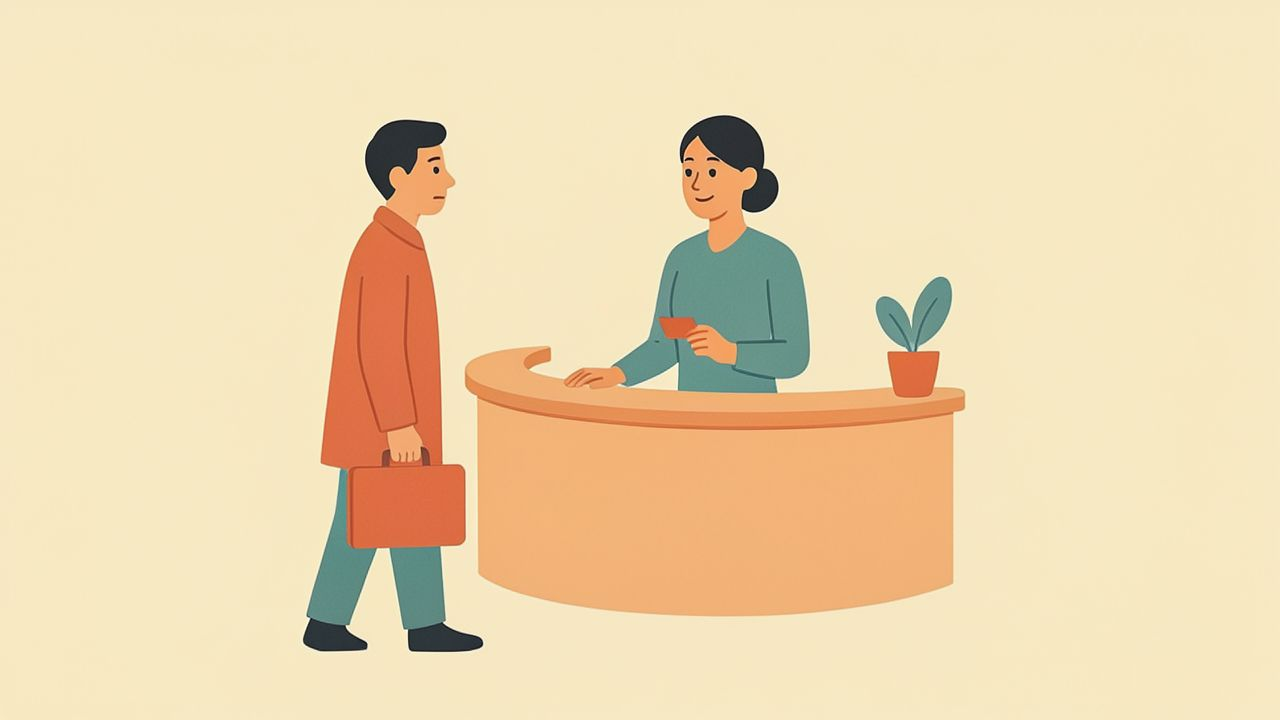
The reception desk of a German hotel is where every other department is judged. Guests rarely remember who cleaned the room, but they remember exactly how the person at the desk spoke to them when they arrived tired and when something went wrong.
The German used here is formal by default, and that is a feature rather than a formality. The polite Konjunktiv forms and the Sie address are what make a complaint sound handled rather than argued with, so learning the register is not decoration, it is the tool of the job.
At the Front Desk: The Words of Check-In
| German term | English meaning |
|---|---|
| die Rezeption | the reception desk |
| der Gast | the guest |
| die Anreise | the arrival |
| die Abreise | the departure |
| die Anmeldung | the registration on arrival |
| der Zimmerschlüssel | the room key |
| die Zimmerkarte | the key card |
| der Empfang | the welcome |
Check-in in Germany is short and procedural, and guests expect a few set sentences rather than conversation. The sequence is always name, booking, document, key, and breakfast time, and a receptionist who has those five steps fluent can handle a lobby of twenty people without hesitating.
Room Types and What Guests Actually Ask For
| German term | English meaning |
|---|---|
| das Einzelzimmer | the single room |
| das Doppelzimmer | the double room |
| das Zustellbett | the extra bed |
| das Nichtraucherzimmer | the non-smoking room |
| die Zimmerkategorie | the room category |
| das ruhige Zimmer | the quiet room |
| der Blick zum Hof | the room looking onto the courtyard |
| die Verbindungstür | the connecting door |
Guests rarely ask for a category; they ask for an outcome such as quiet, a view, or two beds instead of one. Learning to restate a request as a concrete room, in one sentence, is the fastest way to make a guest feel that they were heard rather than processed.
Registration and the Law
| German term | English meaning |
|---|---|
| das Bundesmeldegesetz | the federal registration act for guests |
| die Meldedaten | the guest data that must be recorded |
| der Ausweis | the identity document |
| die Aufbewahrungsfrist | how long the data must be kept |
| der Meldeschein | the older registration form |
| die Datenschutzerklärung | the privacy notice |
| die Einwilligung | the consent |
| die Weitergabe an Behörden | disclosure to the authorities |
German hotels are required to record guest data and keep it for a set period, and the data may be requested by the authorities. Guests sometimes object to handing over a document, so reception staff need one calm, correct sentence that explains the duty without making it sound like suspicion.
Handling Requests Without Saying No
| German phrase | What it does |
|---|---|
| "Ich kümmere mich darum." | takes ownership of the request |
| "Ich prüfe das gerne für Sie." | promises a check, not an outcome |
| "Das lässt sich einrichten." | agrees in the form the hotel can deliver |
| "Ich verbinde Sie mit dem Housekeeping." | routes the request correctly |
| "Möchten Sie einen Weckruf?" | offers the standard services |
| "Ich notiere das für die Kollegen." | passes it into the written handover |
The difference between "Das geht nicht" and "Das lässt sich vielleicht einrichten" is the whole of German service culture, and the second one is not dishonest if it is followed by a real answer. Guests accept a refusal far better when it arrives after an attempt rather than instead of one.
Complaints and Compensation
| German term | English meaning |
|---|---|
| die Beschwerde | the complaint |
| die Reklamation | the formal complaint about a service |
| die Entschuldigung | the apology |
| die Unannehmlichkeit | the inconvenience |
| die Wiedergutmachung | making it right |
| die Kompensation | the compensation |
| die Eskalation an die Leitung | escalation to the manager |
| das Beschwerdeprotokoll | the written complaint record |
A complaint is handled in three moves, namely acknowledge, act, and confirm in writing, and skipping the third is what turns a solved problem into a review. In Germany the apology should be specific rather than broad: naming what went wrong sounds sincere, while repeating "Es tut mir leid" sounds rehearsed.
Billing, Taxes and Departure
| German term | English meaning |
|---|---|
| die Rechnung | the invoice |
| die Kurtaxe | the local tourist tax |
| die Übernachtung | the overnight stay |
| die Frühstückspauschale | the flat breakfast charge |
| die Halbpension | half board |
| der Firmenpreis | the corporate rate |
| die Zahlungsart | the method of payment |
| der Beleg | the receipt |
Many German towns charge a local tourist levy, usually collected by the hotel and passed on, and guests are often surprised by the line on the bill. Explaining it at check-in, rather than at departure, removes the single most common source of friction at the desk.
The Shift Handover
| German term | English meaning |
|---|---|
| die Übergabe | the shift handover |
| das Übergabebuch | the handover book |
| der offene Vorgang | the task still unfinished |
| die Notiz im System | the note in the hotel system |
| der Sonderwunsch | the special request |
| die Nachtschicht | the night shift |
| der Schichtleiter | the shift leader |
| die Reklamation in Bearbeitung | the complaint still being handled |
The handover is where guest promises either survive or disappear, and in a German hotel it is written rather than remembered. A note that says which room, which promise and by when is worth more than a paragraph of description, because the colleague on the next shift reads it in ten seconds.
When the Hotel Is Full
| German term | English meaning |
|---|---|
| die Auslastung | the occupancy rate |
| das ausgebuchte Haus | the fully booked hotel |
| die Überbuchung | the overbooking |
| die Warteliste | the waiting list |
| die Umbuchung | the rebooking |
| das Ausweichhotel | the alternative hotel |
| die Entschädigung | the compensation |
| die Kulanz | the goodwill gesture |
An overbooked house is not a rare emergency but a routine risk, because rooms are sold before cancellations are known. The German approach is to solve it before the guest discovers it, with a comparable room nearby, the difference paid and the explanation given in person rather than at the door.
The word that carries the whole conversation is Kulanz, meaning a gesture made without admitting legal fault. Offering goodwill early costs a taxi fare; offering it after a guest has argued at the desk costs the booking, the review and often the corporate account behind it. You can learn German for hotel reception with the vocabulary of check-in, rooms and complaints built in.
The bars show the order of the stages; each value is a sequence number rather than a duration.
Working at a German Hotel Reception
Large hotels recruit receptionists with hotel training or with a commercial background, and foreign-language ability is a stated requirement rather than a bonus. Shift work is normal, the systems are almost always computerised, and a working knowledge of German at B2 level is the usual minimum for a role that involves complaints.
Interviews usually include a role play, and the scenario is almost always a guest who is unhappy about a room. If you want to learn German for hotel reception, build the vocabulary of registration, room types and polite refusals first, because those three areas make up most of the day.
German hotel reception is built on fluent, formal courtesy. Learn German with check-in, guest-request and complaint-handling vocabulary built into the course.
Put your German to work. The LanguageSkills German course is self-paced and built around real situations like these — you speak, and your AI tutor corrects you on the spot, from A1 to B2.