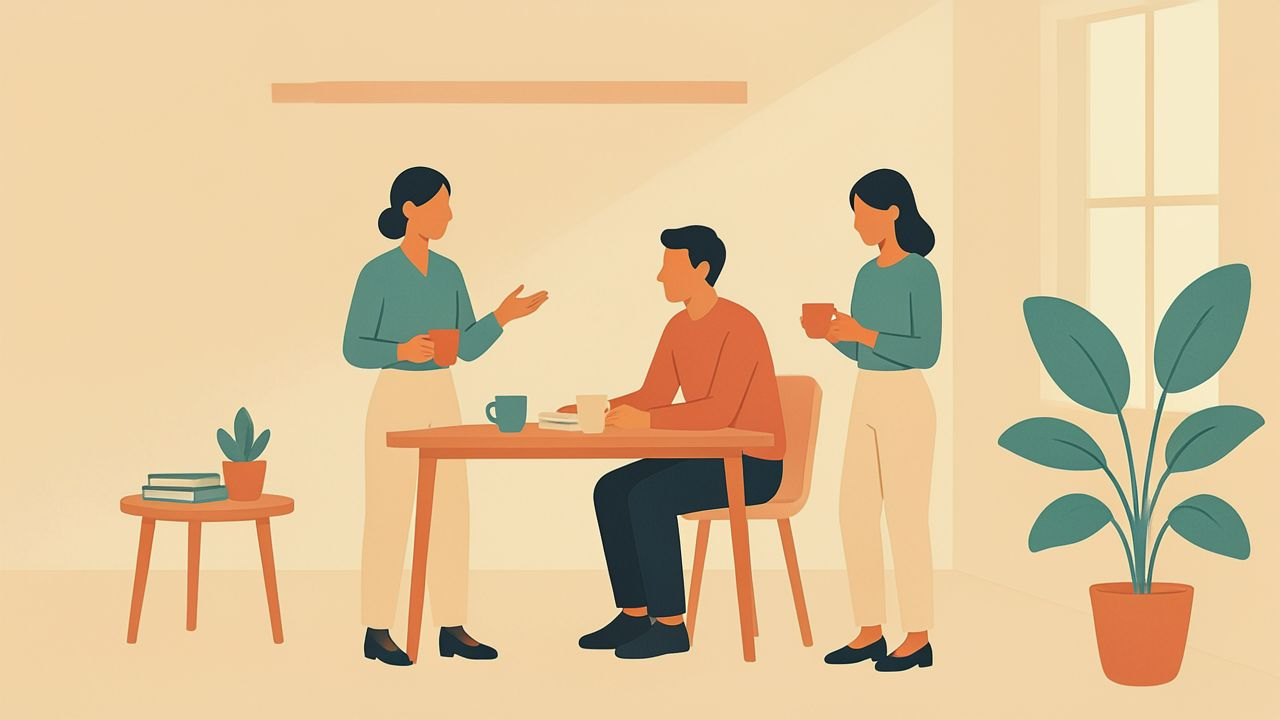
Small talk is where working life becomes pleasant, and in Germany it follows clearer rules than newcomers expect. It is not gossip, and it is not a test, but it has its own safe subjects and its own boundaries.
The German break room is friendly and, at the same time, private: personal questions are asked later and more slowly than in many other countries. Learning the accepted topics is what turns an awkward silence into an easy conversation.
The Words of the Break Room
| German term | English meaning |
|---|---|
| die Pause | the break |
| der Pausenraum | the break room |
| die Teekueche | the kitchenette |
| der Kollege | the colleague |
| das Betriebsklima | the workplace atmosphere |
| die Mittagspause | the lunch break |
| der Feierabend | the end of the working day |
| die Schicht | the shift |
German breaks are taken at fixed times and for a fixed length, and the Feierabend is protected with real seriousness. Starting a conversation with a colleague at the machine is normal; interrupting a task to chat is not.
Safe Subjects
| German term | English meaning |
|---|---|
| das Wetter | the weather |
| der Verkehr | the traffic |
| der Urlaub | the holiday |
| das Wochenende | the weekend |
| der Sport | the sport |
| das Essen | the food |
| die Region | the area, the region |
| die Anreise | the journey to work |
Weather, traffic, holidays and food are always safe, and nearly every German break contains one of them. Local football is a reliable opener, and asking which club a colleague supports is an easy and welcome question.
Subjects to Handle Carefully
| German term | English meaning |
|---|---|
| das Gehalt | the salary |
| die Politik | the politics |
| die Religion | the religion |
| die Krankheit | the illness |
| das Alter | the age |
| die Familie | the family |
| die Bewertung | the performance rating |
| der Konflikt | the conflict |
German colleagues rarely discuss salary, and comparing pay openly is still unusual. Politics and religion are discussed between friends but avoided in the break room, and questions about family are asked once a relationship has formed.
Taking the Initiative
| German term | English meaning |
|---|---|
| Guten Morgen | good morning |
| Wie war Ihr Wochenende | how was your weekend |
| Wie geht es Ihnen | how are you |
| Darf ich mich dazusetzen | may I join you |
| Was machen Sie in Ihrer Freizeit | what do you do in your free time |
| Sind Sie neu hier | are you new here |
| Koennen Sie mir kurz helfen | could you help me briefly |
| Bis morgen | see you tomorrow |
Greeting colleagues on arrival is expected rather than optional, and skipping it is noticed. Sitting down next to someone with a clear question is an accepted way to start, because it gives the conversation a purpose.
From Sie to Du
| German term | English meaning |
|---|---|
| das Sie | the formal address |
| das Du | the informal address |
| das Du anbieten | to offer the informal form |
| die Anrede | the form of address |
| der Vorname | the first name |
| der Nachname | the surname |
| die Kollegin | the female colleague |
| die Hierarchie | the hierarchy |
In most German firms the du is offered by the more senior person or by the older colleague, and it applies from that moment. In a workshop the du is normal from the start, while in a bank or an authority the Sie may last for years.
Team Life Beyond the Workplace
| German term | English meaning |
|---|---|
| der Betriebsausflug | the company outing |
| die Betriebsfeier | the company party |
| das Sommerfest | the summer party |
| die Weihnachtsfeier | the Christmas party |
| der Geburtstagskuchen | the birthday cake |
| die Kaffeekasse | the coffee kitty |
| der Feierabendtrunk | the after-work drink |
| das Sammelgeschenk | the collective gift |
German teams collect money for birthdays, departures and illnesses through a Kaffeekasse, and contributing is part of belonging. Company parties are well attended and behave formally at the start and considerably less so by the end.
Keeping It Going
| German term | English meaning |
|---|---|
| die Gemeinschaft | the community |
| die Wertschaetzung | the appreciation |
| die Nachfrage | the enquiry |
| das Gespraech | the conversation |
| die Offenheit | the openness |
| das Interesse | the interest |
| die Routine | the daily routine |
| die Zusammenarbeit | the cooperation |
Small talk in a German workplace is cumulative rather than intense: a few sentences every day build a working relationship over months. Remembering one detail from the previous conversation is the single most effective habit.
Building a Good Working Reputation
| German term | English meaning |
|---|---|
| die Zuverlaessigkeit | the reliability |
| die Puenktlichkeit | the punctuality |
| die Sorgfalt | the care, the thoroughness |
| die Verschwiegenheit | the confidentiality |
| die Hilfsbereitschaft | the helpfulness |
| die Eigenverantwortung | the personal responsibility |
| das Engagement | the commitment |
| das Vertrauen | the trust |
A reputation in a German workplace is built from small, repeated signals: arriving on time, finishing what was promised and telling people in advance when something will slip. One missed deadline costs more than several modest weeks.
Verschwiegenheit is part of the contract in many roles, and it is also part of the culture. What is said in a meeting stays with the people in the room, and forwarding an internal message casually is remembered for years.
Hilfsbereitschaft is valued but bounded: German colleagues help when they are asked, and expect you to handle your own area afterwards. Being the person who never says no sounds generous and is quickly read as poor judgement about time.
Eigenverantwortung means owning your area, including its problems, and escalating at the right moment rather than the last one. A short message with the facts and a proposed solution is the most effective form of communication in a German team.
Engagement shows itself in attention rather than in hours, and a long day spent on the wrong task is not admired. Asking what the priority is, and then proving that you delivered it, is how a German reputation is actually made. If you want to hold your own in a German break room, learn German with small talk and colleague language built into the course.
The bars show the order of the stages; each value is a sequence number rather than a duration.
Working Relationships in Germany
German colleagues are often reserved at first and genuinely helpful afterwards, and the bridge between the two is small talk in the break room. The language needed is simple, but it has to be used daily rather than learned once.
A few phrases, repeated honestly, do most of the work. If you want to learn German for the workplace, the vocabulary of breaks, weekends and team life is a small investment with a large return.
German team life is built on daily greetings and a few safe subjects. Learn German with break-room, colleague and small-talk language built into the course.
Put your German to work. The LanguageSkills German course is self-paced and built around real situations like these — you speak, and your AI tutor corrects you on the spot, from A1 to B2.