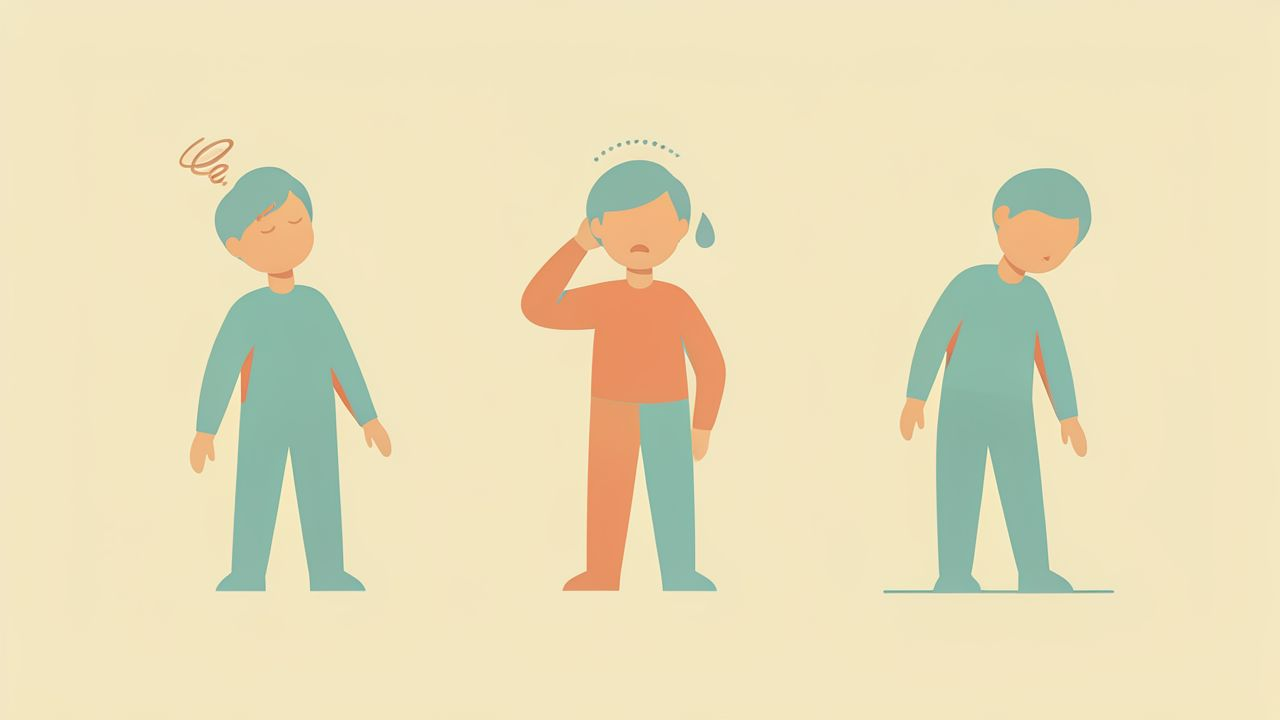
Symptoms are where learners most often produce German that is grammatical but wrong. "Ich bin übel" and "Mir ist übel" use the same words and mean different things to a German ear. Getting the construction right is what turns a patient's answer into usable clinical information.
This guide covers the three symptoms in your question, plus the surrounding vocabulary that comes up with them.
The Dative Construction You Need
Most German symptom expressions use the dative, not the nominative. The person is not the subject; the symptom happens to them.
| Correct | Common learner error | English |
|---|---|---|
| Mir ist übel. | Ich bin übel. | I feel nauseous. |
| Mir ist schwindelig. | Ich bin schwindelig. | I feel dizzy. |
| Mir ist schlecht. | Ich bin schlecht. | I feel unwell. |
| Mir ist warm. | Ich bin warm. | I feel hot. |
| Mir wird schwarz vor Augen. | Ich sehe schwarz. | My vision is going black. |
The difference matters. "Ich bin übel" can be read as describing a person's character rather than their stomach.
If you want to describe and understand symptoms precisely in German, learn German with clinical vocabulary taught in real patient conversations.
Dizziness: Four Different Things
German distinguishes types of dizziness that English often lumps together, and the distinction is clinically meaningful.
| German | English |
|---|---|
| der Schwindel | dizziness, general term |
| der Drehschwindel | rotational vertigo, the room spins |
| der Schwankschwindel | swaying sensation, like being on a boat |
| die Benommenheit | light-headedness, feeling foggy |
| der Lagerungsschwindel | positional vertigo, triggered by movement |
| die Gangunsicherheit | unsteady gait |
A patient who says "Es dreht sich alles" has rotational vertigo. A patient who says "Ich fühle mich benommen" has something else entirely. Ask which.
Nausea and Vomiting
| German | English |
|---|---|
| die Übelkeit | nausea |
| der Brechreiz | retching, urge to vomit |
| das Erbrechen | vomiting |
| sich übergeben | to vomit |
| die Appetitlosigkeit | loss of appetite |
| der Magendruck | pressure in the stomach |
| der Völlegefühl | feeling of fullness |
The question that gets you a useful answer is "Ist Ihnen übel, oder haben Sie sich übergeben?" Nausea and vomiting are recorded differently.
Fatigue, and the German Word You Should Know
German has a wider range of tiredness words than English, and one of them appears in clinical records constantly.
| German | English | Register |
|---|---|---|
| müde | tired | everyday |
| erschöpft | exhausted | everyday and clinical |
| abgeschlagen | washed out, no energy | very common in clinical notes |
| schlapp | weak, listless | colloquial |
| kraftlos | lacking strength | clinical |
| ausgelaugt | drained | colloquial |
Abgeschlagen has no single English equivalent, which is exactly why it is worth learning. "Der Patient ist abgeschlagen" is a standard German clinical observation meaning that the patient has no energy, without specifying whether that is sleepiness, weakness or low mood.
The Symptoms That Travel With These Three
| German | English |
|---|---|
| die Kurzatmigkeit | shortness of breath |
| das Herzrasen | palpitations |
| der Nachtschweiß | night sweats |
| die Kraftlosigkeit | general weakness |
| das Kribbeln | tingling |
| die Taubheit | numbness |
| die Sehstörung | visual disturbance |
| die Sprachstörung | speech disturbance |
| der Tinnitus | ringing in the ears |
| die Ohnmacht | fainting, syncope |
From Patient Words to the Record
Information expands and becomes more technical as it moves from the patient's mouth to the file. Learning all three registers is what makes you useful.
| Patient says | You record |
|---|---|
| "Mir ist schwindelig." | "Patient klagt über Schwindel." |
| "Es dreht sich alles." | "Patient beschreibt Drehschwindel." |
| "Mir ist übel." | "Patient gibt Übelkeit an." |
| "Ich bin total fertig." | "Patient wirkt deutlich abgeschlagen." |
| "Mir wird schwarz vor Augen." | "Patient berichtet über kurzzeitige Sehstörung." |
Ten Questions That Get You the Detail
"Ist Ihnen übel oder schwindelig?" - Are you nauseous or dizzy?
"Dreht sich alles, oder schwanken Sie eher?" - Is everything spinning, or are you more swaying?
"Seit wann geht das so?" - Since when has it been like this?
"Kommt es plötzlich oder langsam?" - Does it come suddenly or gradually?
"Wird es besser, wenn Sie sich hinlegen?" - Does it improve when you lie down?
"Haben Sie sich übergeben?" - Have you vomited?
"Können Sie etwas essen?" - Can you eat anything?
"Wie viele Stunden schlafen Sie nachts?" - How many hours do you sleep at night?
"Fühlen Sie sich heute anders als gestern?" - Do you feel different today than yesterday?
"Haben Sie noch andere Beschwerden?" - Do you have any other symptoms?
Three Mistakes Worth Avoiding
Using "Ich bin" instead of "Mir ist". This is the single most common error in this vocabulary area, and it changes the meaning.
Treating Schwindel as one thing. Ask the follow-up question. Drehschwindel, Schwankschwindel and Benommenheit point in different clinical directions.
Recording the patient's colloquial phrase directly. "Ich bin total fertig" is not documentation language. Translate it into an observation such as abgeschlagen or erschöpft.
The One Question That Changes the Assessment
After the patient describes the symptom, one question decides the next step: "Seit wann?" Onset separates the routine from the urgent, and German documentation records it in a fixed way.
Akut means sudden, within hours. Schleichend means gradual, over days or weeks. Rezidivierend means recurring. Chronisch means present for months. These four words go into the record instead of a description, and they carry clinical weight: a schleichender Schwindel points somewhere very different from an akuter Schwindel mit Drehcharakter.
The second fixing question is severity, and German uses the zero-to-ten scale patients already understand: "Auf einer Skala von null bis zehn, wie stark ist es jetzt?" Record the number, not the adjective, because Zahlen survive a handover and Wörter do not.
Then comes the pattern question: "Was macht es schlimmer, was besser?" In German the answers are short and standard: "Beim Aufstehen", "In Ruhe", "Beim Essen", "Beim tiefen Einatmen". Each phrase is a clinical clue and a ready-made documentation phrase at once.
Three questions, three answers, and the assessment is structured. That is the whole craft of symptom language, and it is the reason to learn German around symptom interviews rather than around word lists.
Building the Reflex
These three symptoms arrive together constantly, and patients describe them in unpredictable words. The skill is recognising the pattern behind the phrasing and converting it into German clinical language in the same breath.
Want to understand and describe symptoms accurately in German? Learn German with symptom-based patient conversations at languageskills.net.
Put your German to work. The LanguageSkills German course is self-paced and built around real situations like these — you speak, and your AI tutor corrects you on the spot, from A1 to B2.